

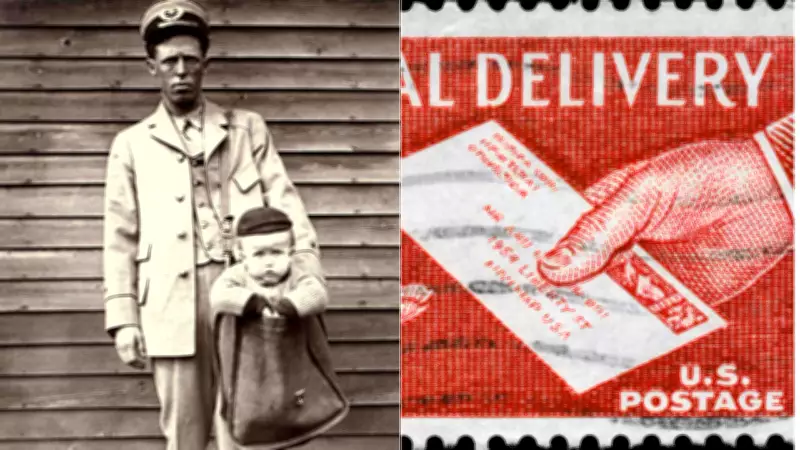
The "instant-delivery era" is often criticized for its obsession with convenience, but over a century ago, there existed a postal delivery service that sounds almost impossible today. While you may trust a delivery agent with expensive purchases, you likely would not trust them with your baby. Yet, in the early 1900s in the United States, people used postal services to send their babies via mail.
How the Bizarre Practice Began
According to The Guinness World Records, mailing babies via postal service was practiced for a brief period between 1913 and 1915. This strange practice took place in the United States after January 1, 1913, when parcel postal services allowed ordinary Americans to send larger packages through the mail. Before this, parcels over four pounds could not be shipped easily. After the service started, rural people found a convenient way to transport goods. Since the rules were still vague, there was no restriction that could stop people from testing their limits, and this is how "mailing babies" became a practice.
Stamps on the Coat, Mailing Tag Around Neck: The Recorded Cases
As per Guinness World Records, one of the first recorded cases was of a baby boy named James Beagle from Ohio. His parents, Jesse and Mathilda Beagle, reportedly paid 15 cents in stamps and insured him for 50 dollars before sending him to his grandparents' home about a mile away. Little James weighed just under the postal service's 11-pound package limit at the time.

Soon more families followed the same practice and sent their babies through postal services. In Oklahoma, a grandmother reportedly mailed her young grandson to relatives in Kansas. The child wore a mailing tag around his neck, and the journey cost only 18 cents.
Perhaps the most astonishing story was that of four-year-old Charlotte May Pierstorff in 1914. Charlotte weighed just under the postal service's 50-pound parcel limit, so her parents attached 53 cents worth of stamps to her coat and sent her by railway mail from Idaho to visit her grandmother 73 miles away. She reportedly rode in the mail compartment of the train and was personally handed over by the postal clerk at the destination.
Why the Mail Carriers Were Trusted So Much
Mail carriers back then were deeply trusted by communities because they did not just deliver letters. They often checked on isolated families, carried medicines, and sometimes even helped in emergencies. More importantly, parents found sending children with a trusted mailman safer as well as cheaper than buying a train ticket.
When the Strange Practice Came to an End
However much the community trusted the service, over time postal authorities realized the obvious risks. There were growing concerns about child safety, legal liability, and the fact that human beings were never meant to be treated as parcels, no matter how trustworthy the mail carrier was. By 1915, after almost two years, the United States Post Office officially banned the mailing of children, thus putting an end to the unusual practice.
A Message for Parents
Certainly, the strange practice came to an end, but it is fascinating to even think that mailing babies existed back then. As for parents, next time you feel guilty about asking someone else to babysit your child for a few hours, just remember, at least you are not putting stamps on them and sending them through the post office.






