In a surprising twist for the world economy, the anticipated shock from sweeping US tariffs has been partially cushioned by an unprecedented spending boom on artificial intelligence. Economists who predicted a downturn are now revising their global growth forecasts upwards, pointing to massive capital expenditures by American technology firms as a key counterbalance.
The AI Spending Spree vs. The Tariff Shock
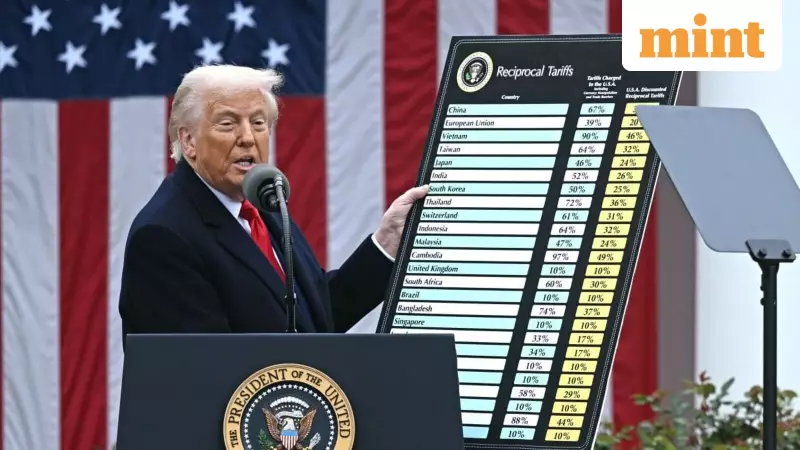
When President Trump announced his "Liberation Day" tariffs in April, analysts braced for a severe global contraction. The logic was straightforward: higher US tariffs would reduce American imports, hurting exports and jobs worldwide. However, the narrative shifted as the year progressed. In October, the World Trade Organization (WTO) significantly increased its 2025 forecast for global merchandise trade volume growth to 2.4%, up from a mere 0.9% predicted in August.
Similarly, the International Monetary Fund (IMF) raised its world growth forecast for 2025 to 3.2% in October, compared to the 2.8% estimate made after the tariff announcement. Both institutions cited a common factor: the colossal investments flowing into AI infrastructure. Tech behemoths like Amazon, Google, Meta, and Microsoft are collectively channeling close to $400 billion this year into capital expenditures, with a dominant focus on artificial intelligence.

An Uneven Global Boom: Winners and Stragglers
While AI acts as a global economic propellant, its benefits are highly concentrated. The United States, representing a quarter of the world economy, saw AI-related investments contribute to as much as half of its GDP growth in the first half of 2025. Beyond the US and China, the rewards are funneled to specific regions embedded in the specialised AI supply chain.
Taiwan, the manufacturing hub for the most advanced semiconductors, is a prime example. Surging American demand for AI chips prompted IMA Asia to revise the island's GDP growth forecast for this year to 7%, a sharp rise from its earlier 4.4% estimate. The group noted Taiwan's capital expenditure on plants and equipment is expected to jump 30% this year. However, this AI-driven boom masks underlying weaknesses, with consumer demand remaining sluggish and other industries facing challenges.
The ripple effect extends to South Korea, a leader in memory chip production, and the Netherlands, home to chip-making equipment giant ASML. According to Oriano Lizza, a trader at CMC Markets, Asia accounted for nearly two-thirds of global AI-related trade growth in the first half of 2025. "The benefits are overwhelmingly concentrated in advanced manufacturing economies," he observed.
The Looming Tariff Cliff and Government Safeguards
Experts caution that the relief provided by AI spending does not erase the impact of tariffs; it merely delays it. Many companies, heeding warnings from Trump's campaign and early second term, engaged in "front-running"—hurrying shipments to the US before tariff deadlines. This artificial boost to trade is now fading.
"It’s too early to say that the tariffs have had less impact than feared," said Mansoor Mohi-uddin, chief economist at the Bank of Singapore. "What’s happening is that the impact has just been delayed." As inventories dwindle, economists anticipate companies will pass on tariff costs to consumers and reduce exports to the US. The WTO's outlook reflects this concern, as it simultaneously upgraded its 2025 forecast while slashing its 2026 projection for trade growth to 0.5%.
Nevertheless, a potential safety net is forming. Fiscal policies from major governments could soften the blow. In the US, the Trump-championed One Big Beautiful Bill Act, extending tax cuts, may provide short-term stimulus. Germany is shifting historically toward increased spending, and Japan has approved a $135 billion stimulus package. Combined with a weak US dollar and potential Federal Reserve rate cuts, these measures could help the global economy navigate 2026, assuming the AI boom sustains its momentum. "The environment for investors is actually still good," Mohi-uddin concluded.