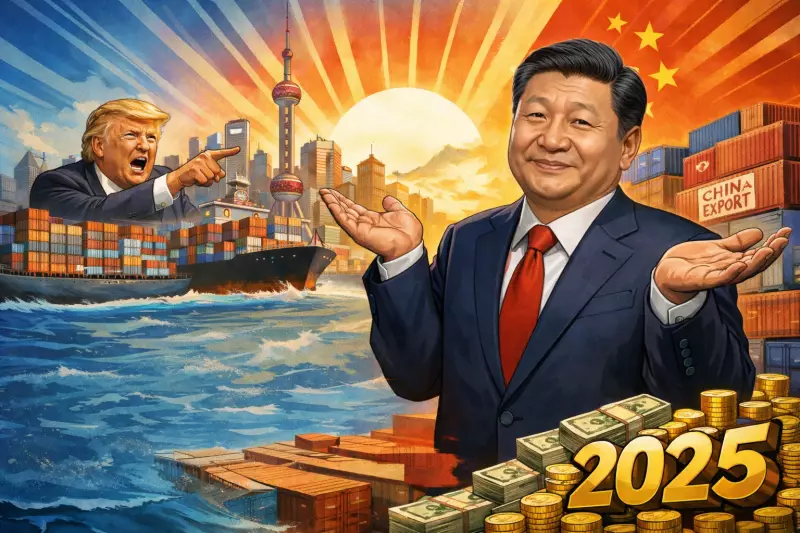
China Smashes Trade Records with $1.2 Trillion Surplus in 2025
China has achieved an unprecedented milestone in global trade. The country finished 2025 with a staggering trade surplus of approximately $1.2 trillion. This figure marks the largest surplus ever recorded by any nation in history.
Customs data released on Wednesday revealed a powerful performance in December. Exports jumped 6.6% compared to the same month last year. This growth rate represents the fastest pace in three months and significantly exceeded economist forecasts. Analysts had predicted a more modest 3.1% increase.
Imports also climbed higher than expected, rising 5.7% year-on-year. This left China with a monthly surplus of $114 billion for December alone. It stands as the biggest monthly surplus in six months and ranks among the highest monthly readings ever documented.

Export Engine Powers Through Tariff Walls
The full-year data tells a compelling story of resilience. China's trade surplus grew by about 20% from 2024 levels. It broke through the trillion-dollar mark before December even arrived. This performance cements a period of trade dominance unmatched by any other major economy.
December's figures demonstrate how quickly Chinese exporters adapt under pressure. Monthly trade surpluses exceeded $100 billion on seven separate occasions in 2025. This is a sharp increase from just one such occurrence in 2024. Export growth consistently beat forecasts throughout the year.
A key development is the shift in trade routes. Shipments to the United States slumped significantly. However, Chinese manufacturers aggressively found new customers elsewhere. They expanded sales to Southeast Asia, Africa, Latin America, and Europe. This strategic pivot largely offset the losses in the American market.
China has not posted a single trade deficit since 1993. Even when adjusted for inflation, the 2025 surplus dwarfs historical peaks from other economic giants. Japan's surplus peaked at an equivalent of roughly $214 billion in today's dollars during the early 1990s. Germany's peak was near $364 billion after Europe's debt crisis. Both figures are merely a fraction of China's current level.
Structural Forces Behind the Surplus
China's record surplus stems from a collision of deep structural forces that tariffs alone cannot easily reverse.
First, manufacturing dominance. China has spent years building immense scale, deep supply chains, and cost advantages across critical industries. These range from automobiles and electronics to batteries, solar panels, and lower-grade chips. Vehicle exports, for instance, jumped 19.4% in 2025. Pure electric vehicle shipments surged nearly 49%, keeping China on track as the world's top auto exporter for a third consecutive year.
Second, weak domestic demand. Imports remain constrained by several factors:
- A prolonged property market downturn
- Falling investment levels
- Cautious consumer spending
Since the housing market crash began in 2021, many households have seen their savings evaporate. This curbs demand for imported goods and even dampens purchases of domestic products. Beijing's long-running industrial policies aimed at import substitution and self-reliance have further suppressed inbound trade, reinforcing the surplus.
Third, currency dynamics. A relatively weak yuan has boosted export competitiveness. While the currency has edged up against the dollar, it lost more than 7% against the euro last year. Adjusted for deflation at home and higher inflation elsewhere, China's real effective exchange rate sits near its weakest level in years. This is a key measure of export competitiveness.
Global Reactions and Political Tensions
The headline number arrives at an awkward moment for Washington and its allies. Higher US tariffs under the Trump administration have reshaped trade routes but failed to reduce China's overall export power. The result is a widening global imbalance.
China's surplus now exceeds one-tenth of its total economic output. It supports millions of factory jobs at home. Abroad, it fuels fears of factory closures, layoffs, and political backlash as cheaper Chinese goods flood foreign markets.

Mounting global unease is the flip side. Countries fear a flood of cheap Chinese goods hollowing out local industries. Targeted tariffs have already appeared in Europe, India, and parts of Southeast Asia. However, none yet match the breadth of the US approach.
International institutions are voicing caution. After China's surplus passed $1 trillion late last year, the International Monetary Fund's Managing Director warned that China should rely less on exports and more on domestic consumption. She stated that as the world's second-largest economy, China is simply too big to generate much growth from exports. Continuing this path risks furthering global trade tensions.
Official Stance and Market Response
Chinese officials argue the surplus reflects economic resilience, not distortion. The Vice Customs Minister noted that trade in 2025 surpassed 45 trillion yuan for the first time, setting a new historical high. He partly blamed weak imports on foreign restrictions, suggesting that if some countries had not politicized trade issues and limited high-tech exports to China, imports would have been higher.
Looking ahead, he said China's market would open more in 2026 and would still be an opportunity for the world. Private-sector economists see exports continuing to do the heavy lifting for growth. They expect exports to act as a major growth driver in the coming year.
Markets have largely shrugged off the latest tariff threats. This week, former President Trump announced a new 25% tariff on countries trading with Iran. This move risks complicating relations with China, the world's top buyer of Iranian oil. The threat could undermine a one-year trade truce between Washington and Beijing. Yet, stocks and bonds barely reacted. Analysts suggest the market does not care about capricious tariff threats and that Trump is unlikely to jeopardize the China truce simply to pressure Iran.
Adjustments and the Road Ahead
Behind the scenes, Beijing is also making adjustments. Authorities have moved to rein in some exports to ease international tensions and curb deflation driven by excess capacity. Export tax rebates on hundreds of products, including solar cells and batteries, will be scrapped starting in April.
Chinese leaders have struck a more conciliatory tone recently. The Premier called for proactively expanding imports and promoting balanced development between imports and exports. This is seen as a signal to trading partners that Beijing recognizes the political costs of runaway surpluses.
Looking into 2026, economists expect export growth to moderate but remain a central pillar of China's economy. Several factors could slow momentum:
- A high base of comparison from 2025
- Rising trade barriers in Europe and emerging markets
- Political pressure over industrial overcapacity
However, strong global demand for competitively priced goods is likely to keep shipments elevated. Chinese firms are also setting up overseas production hubs to reduce their exposure to tariffs.
The bigger uncertainty remains political. Renewed tariff threats, particularly those linked to Iran, risk reopening fault lines with Beijing. Chinese officials have warned they will take appropriate action if Washington violates existing trade agreements.
For now, the data tells a clear and powerful story. Tariffs have bent China's trade flows, but they have not broken the export machine. The lesson of 2025 is blunt. However loudly tariffs are announced, China's export engine has become remarkably adept at driving around them.