China's economic engine showed significant signs of strain in November, with key indicators revealing a sharp slowdown in domestic demand and industrial activity. The latest official data paints a picture of an economy grappling with a persistent property crisis, weak consumer confidence, and growing external pressures, despite a record trade surplus earlier in the year.
Key Indicators Signal a Deepening Slowdown
The most striking figure came from the retail sector, where sales grew by a mere 1.3% year-on-year in November. This marks the weakest performance since December 2022, when the country abruptly ended its stringent 'zero-Covid' policy. The slowdown in consumer spending is broad-based and prolonged, with growth having decelerated for six consecutive months—the longest such streak since 2020.
Parallel to this, industrial production lost momentum, expanding by 4.8%, which represents a 15-month low. The downturn was not confined to consumption and manufacturing. Fixed-asset investment across the nation dropped by 2.6% in the first eleven months of the year, one of the sharpest contractions in decades. The property sector, a traditional pillar of growth, remains in freefall, with investment plunging nearly 16%.

Even previously resilient markets have collapsed. Car sales fell by 8.5%, while home appliance sales witnessed a staggering 19% decline, according to Bloomberg data. The National Bureau of Statistics (NBS) acknowledged the challenges, stating the economy faced "many external instabilities and uncertainties, and domestic demand was insufficient."
The Property Crisis: The Epicenter of Weakness
At the heart of China's consumption problem lies its protracted real estate crisis. For decades, property served as both a growth engine and the primary store of wealth for Chinese households, with an estimated 70% of family assets tied to it. That wealth is now evaporating.
New home prices fell further in November, and property investment dropped 15.9% from January to November. The distress is spreading to developers once considered stable. China Vanke, a giant with state-linked backing, is racing against the clock during a grace period for a bond repayment after investors rejected a delay proposal.
"Developers are struggling to convince investors there are buyers for their apartments," said Fu Linghui, an NBS spokesperson. The International Monetary Fund (IMF) has warned that repairing the sector could cost the equivalent of 5% of GDP over three years, a figure that doesn't capture the profound loss of consumer confidence.
Exports Can't Mask Domestic Imbalances Forever
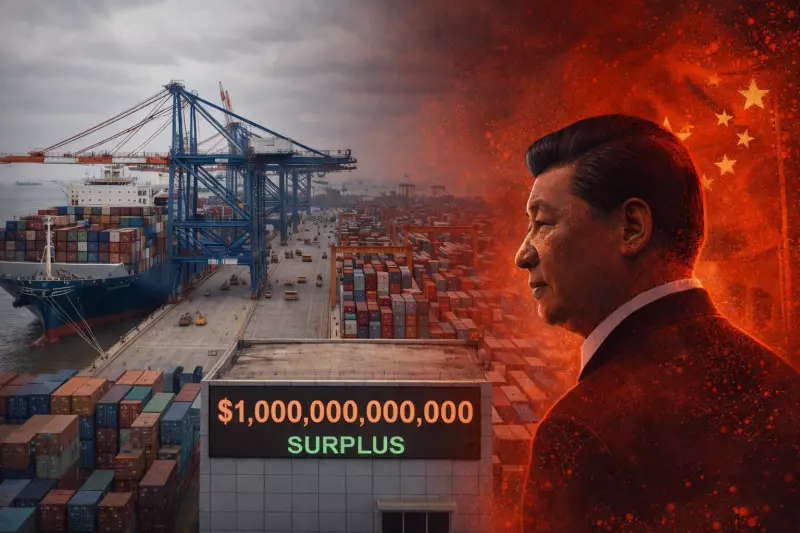
Beijing's strategy for 2025 relied heavily on exports to meet its growth target of around 5%. This worked, resulting in a record $1 trillion trade surplus. However, this lopsided model is showing serious cracks. Strong exports reduced the urgency to stimulate domestic demand, but that internal weakness is now glaring.
Furthermore, the global backlash against China's massive surplus is intensifying. Protectionist measures are escalating from the United States and Europe to Mexico, which approved new tariffs of up to 50% on Chinese imports starting next year. French President Emmanuel Macron labelled China's trade practices "unsustainable."
"China is too large to rely on exports for growth," IMF Managing Director Kristalina Georgieva warned recently. This sentiment echoes a rare rebuke from President Xi Jinping at the Central Economic Work Conference, where he criticized the chase for inflated GDP figures and "reckless" projects, calling for "high-quality, sustainable development."
Outlook: Cautious Stimulus Amid Mounting Challenges
Despite the warning signs, analysts do not expect aggressive new stimulus immediately. Policymakers are likely to stick to moderate measures. The People's Bank of China is expected to cut interest rates modestly in early 2026, and the government may maintain a budget deficit around 4%.
Most economists believe Beijing will set a similar 5% growth target for 2026, a politically symbolic figure likely achieved through modest stimulus and base effects. However, confidence in the medium-term outlook is fading.

Zichun Huang, China economist at Capital Economics, noted, "Policy support should help drive a partial recovery in the coming months, but this probably won't prevent China's growth from remaining weak across 2026 as a whole." Gary Ng, senior economist at Natixis, was blunter, stating that while the 5% target is likely a "done deal," 2026 will be "a much more challenging year if the stress persists."
The bottom line is clear: China's economy is not collapsing but stalling in a subtle, politically uncomfortable manner. Factories operate and exports continue, but within the country, households are cautious, investors are hesitant, and policymakers are caught between the old growth model and new, formidable constraints.