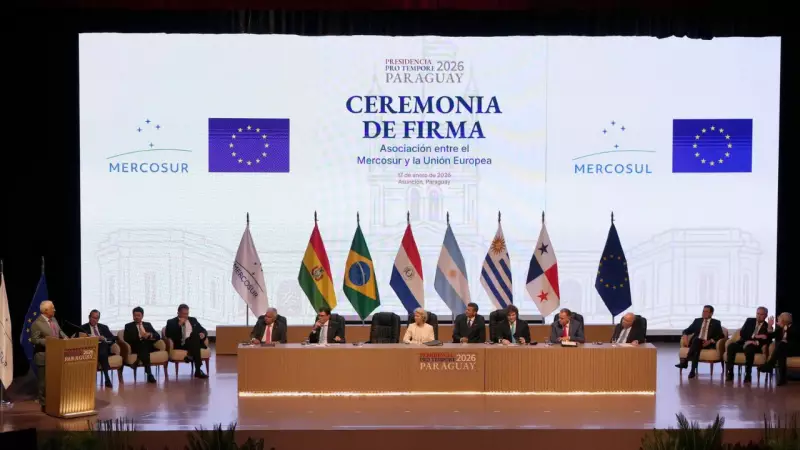
The European Union and the Mercosur trading bloc made history on Saturday. They formally signed a free trade agreement that negotiators had discussed for more than twenty-five years. This landmark pact creates one of the world's largest integrated trading zones.
A Major Geopolitical Milestone
Officials signed the agreement in Asunción, Paraguay. This event marks a significant geopolitical victory for the European Union. It comes at a time of rising global trade tensions, increasing tariffs, and expanding Chinese exports. The deal also demonstrates South America's clear intention to maintain diverse economic and diplomatic relationships. This is particularly important as the United States adopts a sharper trade stance in the Western Hemisphere.
Uniting Two Major Economic Blocs
The agreement brings together a massive combined market. It covers over 700 million people. This represents roughly one quarter of the entire world's gross domestic product. The core aim of the pact is to progressively lower tariffs on the vast majority of goods traded between the two blocs. This opens exciting new opportunities for South American agricultural exporters. It also provides European manufacturers with better access to fast-growing markets.

Leadership Emphasizes Strategic Importance
European Commission President Ursula von der Leyen spoke at the signing ceremony. She stated the agreement carries enormous strategic weight, especially when free trade faces growing pressure globally.
"The geopolitical importance of this agreement cannot be overstated," von der Leyen declared. She added, "We choose fair trade over tariffs. We choose a productive long-term partnership over isolation."
She explained that the pact reflects a shared belief on both sides. Deeper cooperation is the best path to generate growth and prosperity across the Atlantic.
High-Level Attendance and Regional Significance
The ceremony saw attendance from the presidents of Argentina, Uruguay, and Paraguay. Brazil's foreign minister also attended, representing Mercosur's largest economy. For the European Union, this agreement significantly strengthens its footprint in a resource-rich region. This area has become a key focal point of competition between Washington and Beijing.
For Mercosur member nations, the deal promises greatly expanded access to European markets for their agricultural products. It also reinforces their position as serious global trade partners who are not tied to any single power center.
The Road Ahead: Ratification and Future Impact
The accord still faces important ratification processes. Individual EU member states and Mercosur countries must approve it domestically. However, Saturday's formal signing represents the most decisive step taken so far. It moves the world closer to reshaping trade relations between Europe and South America. This reshaping is crucial in an increasingly fragmented global economy.
The successful conclusion of these marathon negotiations signals a powerful commitment to open markets. It establishes a new framework for transatlantic commerce that will influence global trade patterns for decades to come.