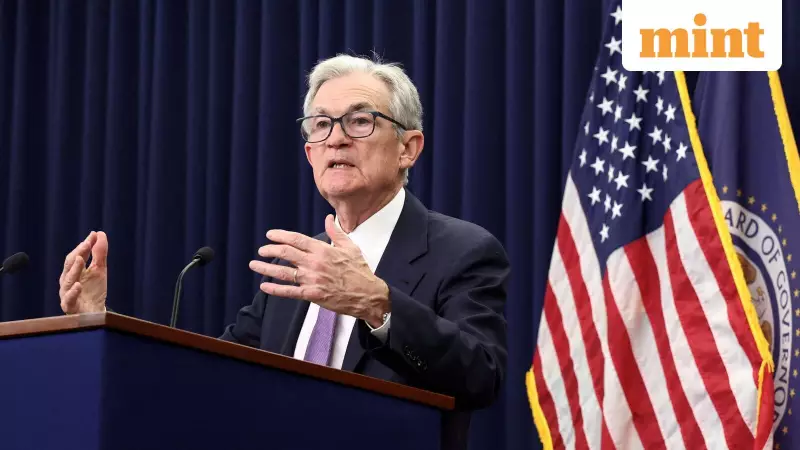
Federal Reserve Chair Jerome Powell is navigating one of the most challenging periods of his tenure, as he prepares for a potential interest rate cut at the December meeting despite significant opposition from within the central bank. This internal rift presents Powell with two unappealing paths, each carrying distinct risks for the US economy.
The Powell Dilemma: To Cut or Not to Cut
The unusual level of division inside the Fed means the final decision rests heavily on Powell's shoulders. He is likely weighing two primary approaches, both with serious drawbacks. The first option involves cutting rates as financial markets expect, then using carefully crafted post-meeting language to signal a pause in further reductions. This "cut then hold" strategy mirrors Powell's approach in late 2019 when he faced similar resistance from colleagues after three rate cuts.
This path would likely trigger objections from officials who oppose any cut but could potentially end the public airing of disagreements by establishing a new consensus that further cuts aren't warranted if current economic conditions persist.

The alternative is to hold rates steady in December and reassess in January, when officials will have more employment and inflation data that was delayed by a recent federal government shutdown. However, this approach could prolong the public discord for another seven weeks with no guarantee that additional data will resolve the fundamental disagreements.
Economic Crosscurrents Fuel Fed Division
The division reflects economic crosscurrents that have split the committee more than at any point in Powell's nearly eight-year tenure. Job growth is stagnating while inflation remains uncomfortably elevated, creating what economists call stagflation concerns. Richmond Fed President Tom Barkin summarized the dilemma last week, noting that with the labor market cooling but not collapsing and inflation neither accelerating nor improving meaningfully, "it's hard to declare victory" on either side.
Powell's decision ultimately depends on what he considers the greater risk and which would be harder to correct if he's wrong. Two consecutive cuts have already brought rates down to a range between 3.75% and 4% last month, intended to guard against softening job-market conditions even as inflation has run closer to 3% than the Fed's 2% target.
Key Allies Signal Support for December Cut
Two of Powell's top allies on the rate-setting committee have recently signaled that Fed leadership hasn't abandoned the strategy Powell outlined in August: moving rates closer to neutral because tariff-related inflation risks had lessened while labor-market weakness had become a greater concern.
On Friday, New York Fed President John Williams stated he still saw "room for a further adjustment in the near term... to move the stance of policy closer to the range of neutral." His carefully chosen words, particularly "near term," suggested cutting is the path of least regret. Market-implied probability of a December cut flipped to around 70% from 40% after his comments.
San Francisco Fed President Mary Daly, a Powell ally who doesn't vote on interest-rate decisions this year, said in an interview Monday that she supports cutting rates in December. She views a sudden deterioration in the job market as both more likely and harder to manage than an inflation flare-up. "On the labor market, I don't feel as confident we can get ahead of it. It's vulnerable enough now" that if layoffs start to rise slightly, they could increase substantially, Daly explained.
The comments from Williams and Daly are significant because they follow a period when officials opposing a cut dominated the public debate. However, resistance to a third cut became more apparent after the second reduction in October. Four voting Fed presidents, including one who dissented last month, have signaled concerns about cutting again. They worry that price growth remains elevated not only for tariff-exposed goods but also for domestic services, suggesting inflation is broadening.

Boston Fed President Susan Collins exemplifies this shift. She voted for October's rate cut but told reporters Saturday she is "hesitant" about further reductions because the current "mildly restrictive" rate setting may be needed to manage inflation. Given relatively solid demand and financial conditions that provide "a bit of a tailwind," she said, "it doesn't suggest urgency to be more accommodative."
The stage is set for a critical December meeting that will test Powell's leadership and determine the Fed's direction amid one of the most challenging economic environments in recent years.