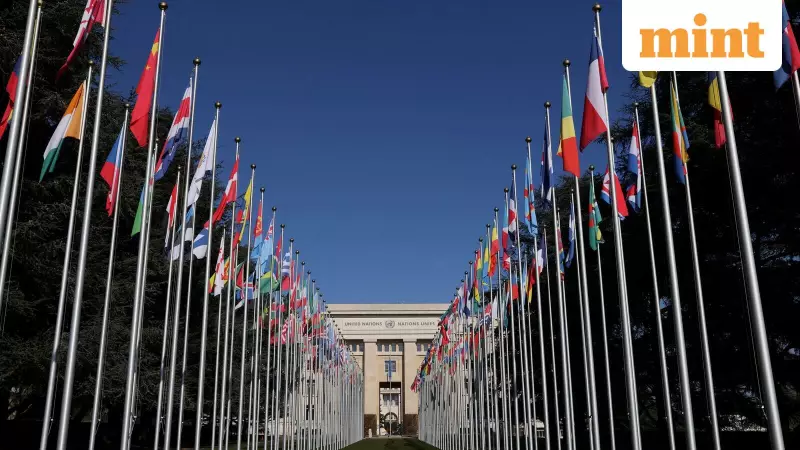
At the start of 2026, the world faces a grim paradox. While global interconnection has never been greater, a dangerous wave of xenophobic nationalism is threatening to tear apart the very fabric of international cooperation. This surge, which sees migrants and refugees dehumanized as existential threats, risks pushing the world into a darker era of division.
The Global Backlash Against the 'Other'
Prominent economist and former Chief Economic Advisor to the Government of India, Kaushik Basu, has issued a stark warning. He observes that political leaders in numerous countries are increasingly casting people fleeing poverty, persecution, and conflict as dangers to society. This rhetoric, he notes, chillingly echoes the sentiments captured by W. H. Auden in his pre-World War II poem Refugee Blues, where refugees were blamed for stealing "our daily bread."
This rise of populist xenophobia is not an accident. Basu argues it is a reaction to a profound structural shift often missed by social scientists who take the nation-state for granted. The nation-state model, a relatively recent construct born when travel was slow, is now under immense strain from globalization. The free flow of goods, capital, information, and people across borders, powered by the digital revolution, has made the world deeply interdependent.

The current hyper-nationalism is a rear-guard action, an attempt to revive an outdated model. Basu draws a parallel to historical norms now deemed abhorrent, like claims of racial superiority. He suggests that assertions of national primacy will, in time, sound equally crude and indefensible.
From Tagore's Vision to Rawls' Veil of Ignorance
The moral argument for universalism—the idea of a shared human identity beyond borders—has deep roots. Basu highlights the work of the late philosopher John Rawls, who advocated for designing a fair society from behind a "veil of ignorance," ignoring one's own nationality, ethnicity, or gender. This intellectual tradition is not confined to the West.
Indian Nobel laureate Rabindranath Tagore repeatedly envisioned a borderless world. In a 1917 essay, he argued that while nations were a practical reality, humanity's ultimate aspiration should be a primary identity as human beings. India's first Prime Minister, Jawaharlal Nehru, acknowledged this vision, calling nationalism a "narrowing creed" and crediting Tagore for pushing Indians to think beyond it.
Yet, a practical question remains: is a borderless world feasible, especially when nationalism has historically driven growth and innovation? Here, Basu finds wisdom in the ancient Greek Stoic Chrysippus of Soli. Chrysippus used sports as a metaphor, advocating for a "no shoving" ethic where competitors strive to win but strictly within the rules. This framework allows fierce competition to coexist with cooperation and shared purpose—a model that could apply to nations.
The Immediate Path: Strengthening Global Institutions
While a world without borders may be a distant ideal, Basu asserts there are concrete, immediate steps to take. The resilience of existing supranational organizations is of critical importance. At a time when nationalism is weakening international cooperation, these bodies must be fortified.
He specifically calls for strengthening:
- The United Nations (UN)
- The Bretton Woods institutions (like the IMF and World Bank)
- The International Criminal Court (ICC)
These institutions, despite their flaws, represent mechanisms for global dialogue, economic stability, and justice that can help check the excesses of virulent nationalism.
As the new year unfolds, Basu's message is one of cautious hope. Nurturing the aspiration for a world where no one is treated as the 'other' is essential. Universalism is a dream, but it is not an impossible one. The choice is between succumbing to the divisive politics of fear or championing the interconnected, humane global order that the 21st century desperately needs.