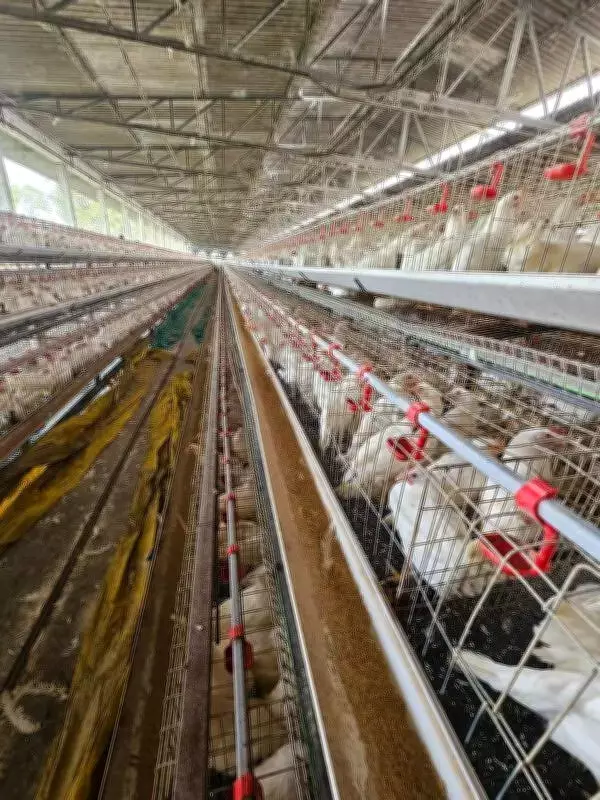
Nashik: Navapur, a tribal-dominated taluka in Nandurbar district that has anchored western India's egg supply since the 1950s, is witnessing a steady collapse of its poultry economy after repeated avian flu outbreaks, dwindling infrastructure and limited institutional support.
The number of poultry farms has fallen sharply from over 60 in 2006 to just 38 in 2026, with successive disease waves in 2006, 2021 and 2026 leaving farmers financially exposed and increasingly unwilling — or unable — to continue.
Despite the decline, Navapur remains a critical food artery. About 12 lakh layer birds currently produce an estimated 10 lakh eggs daily, more than 80% of which are shipped to Surat, alongside supplies to north Maharashtra. But the system sustaining this output is under severe strain.

A legacy under siege
For farmers like Ahmad Dhumadiya, who has worked in Navapur's poultry sector since 1989, the crisis has become cyclical and deeply personal.
"While nature often holds the upper hand, the fear of loss cannot dictate our survival," Dhumadiya said. "I have diversified some of my earnings into other businesses, which helps offset the loss, though it remains painful." Many others have not endured. The 2021 outbreak, in particular, triggered a mass exit, with several farmers shifting to dairy after absorbing repeated financial shocks.
What are layer birds?
Layer birds are female chickens raised specifically for egg production. Unlike broilers bred for meat, layers are engineered for high-volume output, beginning to lay eggs at 18-20 weeks and continuing until around 72–78 weeks.
Why layers are highly vulnerable
The economics of layer farming magnify the impact of disease. While a broiler cycle spans just 45 days, layers require nearly eight months of investment before yielding returns and around 18 months to break even.
Though biologically capable of living 6-8 years, layer hens are typically culled after 2-3 years due to reduced productivity. An infection can wipe out years of investment overnight, leaving farmers exposed without buffers.
The long road to recovery
Recovery from an avian flu outbreak is slow, capital-intensive and often unsupported. Farms must wait 90 days after culling before introducing chicks, followed by another five months before egg production begins.
"Due to its proximity to Surat and established manpower, many farms emerged here starting in 1960," said Arif Belasaria, the president of the Navapur Poultry Association. "Since an outbreak effectively stalls a business for at least nine months — a duration many small-scale operators simply cannot survive — some establishments have changed hands, while others have left the business entirely," he added.
A farmer on the outskirts, who entered the business in 2018 using personal savings, pointed to another challenge — lack of credit.
"Post-2006, banks blacklisted the poultry industry and are no longer ready to provide financing. We have to arrange funds ourselves. The only silver lining is that my farm has not been affected so far," he said, requesting anonymity.
Compensation vs reality
Farmers say govt compensation falls far short of actual losses. Current payouts stand at Rs 140 per culled bird, Rs 4 per destroyed egg, and Rs 25 per kg of feed.
"An eight-week-old chick costs Rs 250 and has to be nurtured. Feed cost is Rs 32 per kg, and overhead costs are not even accounted for," the farmer explained. "The loss incurred is tremendous. If govt provided subsidies post-infection or facilitated loans through nationalized banks, it could save a business that provides vital employment to people of the region."
Geography as a risk factor
Officials attribute Navapur's vulnerability in part to its geography and density.
"The major problem in Navapur is the high concentration of poultry farms in close proximity. Any infection in one farm is likely to spread like wildfire to the others," said Baburao Narawade, the joint commissioner of animal husbandry, Nashik region.
Navapur's role as a transit hub compounds the risk. Broilers from north Maharashtra and Nashik pass through en route to Surat, while nearly 70% of spent hens (older egg-laying hens whose productivity has dropped) from across Maharashtra and South India are routed to the taluka for consumption.

"If broilers develop an infection during their 45-day cycle, they pass it to our birds while passing through Navapur. The spent hens brought here for consumption are also likely to carry infections," Belasaria said. "We are urging govt to reroute chicken transportation to bypass our poultry clusters."
Vaccination for birds
Farmers argue that prevention, not compensation, is key to survival. They are demanding vaccination protocols similar to those followed internationally.
They stress that protecting layer birds is essential not just for their livelihoods but for national nutrition. Eggs remain one of the most accessible protein sources, and Navapur's scale makes it indispensable.
Without intervention, farmers warn, continued exits from the sector could trigger supply shocks—turning a local crisis into a broader food security concern.
You Can Also Check: Gold Rate in Nashik | Silver Rate in Nashik | Bank Holidays in Nashik | Public Holidays in Nashik