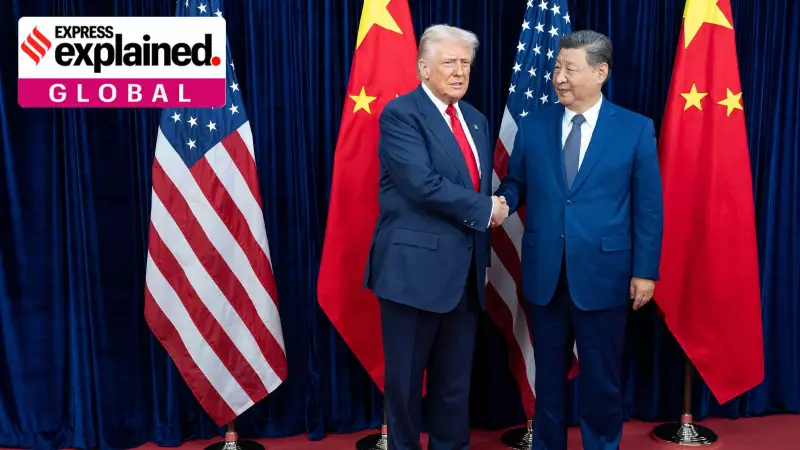
Trump's Unintended Effect: Making China Great Again
President Donald Trump rode the Make America Great Again wave to power, but his actions in office are having a surprising side effect. They are making China great again. This shift is forcing a reset of global trade relationships.
A Year of Blitz and Upheaval
The first year of Trump's second term has been a whirlwind. He signed hundreds of executive orders. He launched a trade war. The US withdrew from major international agreements. Mass deportations were ordered. Three countries faced bombings: Yemen, Iran, and Nigeria. A sitting president was extracted from Venezuela to face trial in New York.
Before Trump took office, Russia was seen as Europe's biggest threat. Now, almost unthinkably, the United States fills that role. Investors are flocking to safe-haven assets like gold and silver, pushing them to record highs. This move comes amid a choppy geopolitical and economic outlook triggered by an unexpected actor: the leader of the world's largest economy.

China's Trade Surge Amidst Turbulence
Trump aimed to isolate China with trade curbs and technology restrictions. One year later, China's trade surplus has surged to new highs. In December 2025, Beijing's trade surplus hit a record level, roughly equivalent to the GDP of a top 20 economy. China's economy expanded by a strong 5% last year, meeting its official target. A record trade surplus boosted this growth.
This trade bonanza overshadowed China's domestic struggles. These included efforts to boost spending and a lingering property crisis. Trump's tariff policies caused turbulence, but China countered by integrating better with the world.
Global Pivot to Beijing
Countries are increasingly turning to China as the US steps back from its post-war role. The US was once a facilitator of global trade and an architect of world order. Now, nations are finding ways around America and ramping up partnerships among themselves.
Canadian Prime Minister Mark Carney's visit to Beijing exemplifies this shift. Observers called it a pivotal moment. Carney and Chinese leader Xi Jinping announced a new strategic partnership. Beijing will lower tariffs on Canadian canola seed and seafood. Ottawa will allow 49,000 Chinese electric vehicles into its market.
Carney's visit ended nearly a decade of strained ties. The last Canadian Prime Minister to visit China was Justin Trudeau in 2017. Carney is just the latest in a series of world leaders heading to Beijing. South Korea's Lee Jae Myung visited earlier this month, the first such trip since 2019. Britain's Keir Starmer is expected in January, and Germany's Friedrich Merz will visit next month.
Shifting Supply Chains and Global Flows
A recent analysis by the DHL Global Connectedness Tracker confirms this trend. Global trade is shifting, and supply chains are stretching further than ever. Average trade distances have hit record levels. Trade in Asia, West Asia, and Africa is increasing, outweighing the shrinkage of US trade.
The tracker, published in October 2025, tracks goods, capital, information, and people flows across over 180 countries. It shows that despite geopolitical turbulence and America's withdrawal, global flows remain near historic highs. Global trade had an unusually strong start to 2025, driven by front-loading ahead of expected tariff changes.
Public Opinion and Global Influence
According to a January 2026 paper by Timothy Garton Ash and colleagues, many people expect China's global influence to grow over the next decade. More now view Beijing as an ally or necessary partner. America remains influential, but few expect it to gain in influence. Expectations of Trump are lower than 12 months ago in most countries.
The paper notes that Trump did not enter politics to make China great again. But that is what he has done in the eyes of the world, according to polls. A year after Trump's return, many believe China is on the verge of becoming even more powerful. America's traditional enemies fear it less, while allies worry about falling victim to a predatory US.

Europe's Split and Rearmament
This splitting of the West is most visible in Europe. A poll of 25,949 respondents across 21 countries in November 2025 found that Russians now regard the EU as more of an enemy than the US. Ukrainians look more to Brussels than Washington for help. Most Europeans no longer consider America a reliable ally, and they are keen to rearm.
China's Trade Decoupling
Alexander Al-Haschimi and colleagues wrote in the ECB Economic Bulletin of July 2025 that before the COVID-19 pandemic, Chinese exports and imports moved in tandem. Since then, a clear decoupling has occurred. Goods exports have risen well above their pre-pandemic trend, while goods imports have stagnated below their 2021 level. This resulted in a large trade surplus, a trend widened by Trump's actions.
India's Strategic Pivot
New Delhi has also pivoted somewhat in its dealings with China. This marks a practical rebalancing of foreign policy options, largely in reaction to the soured economic relationship with the US under Trump. Border issues and strategic misalignments persist, but some low-hanging fruit in bilateral engagement has been addressed.
Reciprocity from Beijing is now seen as warranted before further easing restrictions on India's side. This includes accommodating Indian business interests and easing curbs in areas like rare earth magnets.
Meanwhile, India's exports to China soared in December, while shipments to the US declined. Trump's steep tariffs prompted New Delhi to focus on alternative markets. Exports to China surged nearly 70% to $2 billion in December. Goods shipped to the US dropped nearly 2% to $6.8 billion, according to government data.
The US has slapped 50% tariffs on New Delhi, among the highest on any country. This is even higher than tariffs on China, upending trade and diplomatic engagements between the two nations.