

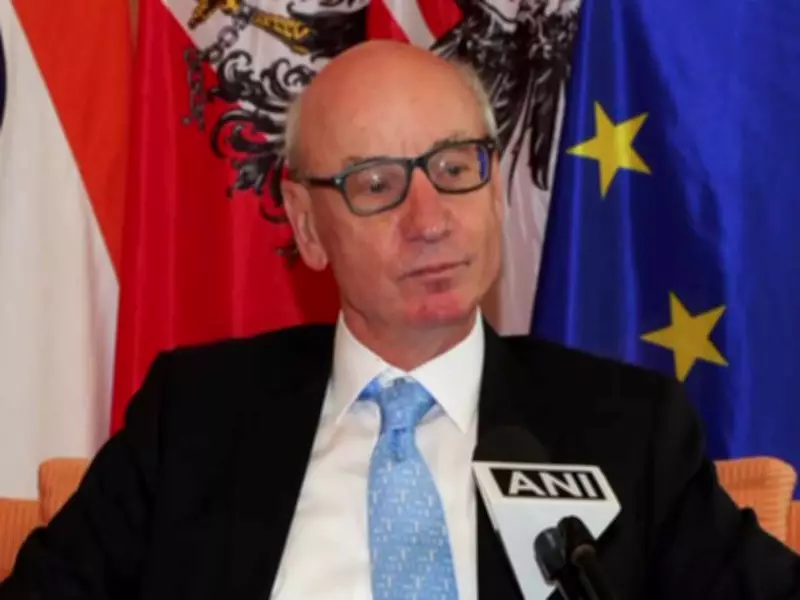
Austrian Ambassador to India Robert Zischg has emphasized the need to ensure Indian students feel at home while pursuing higher education in Austria, highlighting a dedicated onboarding programme designed to prevent loneliness under the India-Austria mobility partnership. In an interview with ANI, Zischg said the initiative is one of the most significant outcomes of the India-Austria Memorandum on Mobility and Migration, signed in 2023.
Onboarding programme details
According to Zischg, the programme is led by Technical Universities Austria, a consortium comprising the Technical University of Vienna, the Technical University of Graz, and the Technical University of Leoben. It is implemented in collaboration with several Indian Institutes of Technology (IITs), including those in Mumbai, Delhi, and Bengaluru. The programme goes beyond classroom education by familiarizing students with Austrian culture and daily life before they relocate, recognizing that many are experiencing living abroad for the first time.
“So there are already some Indian students there who will introduce them to Austrian customs and they take them to the local pubs and show them around. So they do not feel lonely, because this is something which many students experienced in the past when they went somewhere; there was no network, and then you find out, 'I'm alone,'” Zischg said. “And that is with that onboarding programme we want to prevent. We want the Indian students to really feel at home in Austria. And then they might come back; they might stay in Austria. So it is, I think, a beautiful programme.”

Expansion plans and mobility as a pillar
The Ambassador said the initiative began this semester and will be expanded to all three participating Austrian universities in the next winter semester. Describing mobility as an important pillar of India-Austria relations, Zischg stressed that the partnership is not limited to economic cooperation but aims to strengthen people-to-people ties. “It's not only about trade; it's about bringing people together,” he said, adding that Austria is also looking to create legal pathways for skilled professionals.
Zischg called for migration to be viewed more positively while remaining well-managed and beneficial for both countries. “We need to move beyond simply rhetoric and have this topic of migration, which, of course for many reasons, is negatively associated in many quarters, to give it positive momentum because migration has always been a phenomenon also in Europe. People migrate. But of course it needs to be in a very controlled manner so that both sides, the recipient countries and the sending countries, are happy with it,” he stated.
Political exchanges and trade prospects
The Ambassador also called for more high-ranking political exchanges to deepen bilateral ties and expand trade and investment. He expressed hope that Austria's Economy Minister will visit India again early next year, and that Austria's Foreign Minister could visit later this year or early next year. He also expressed hope for reciprocal visits by Indian government ministers to Austria.
Boosting trade and investment remains a top priority for the embassy, Zischg said, noting that around 160 Austrian companies already have subsidiaries in India. “We have already got 160 Austrian companies with subsidiaries here. So this for us is already a very significant number,” he said, adding that there remains substantial scope to expand commercial ties. He also voiced optimism over the proposed India-European Union Free Trade Agreement, saying lower tariffs and reduced non-tariff barriers would unlock greater economic cooperation.
Bilateral ties at an all-time high
Describing bilateral ties as being “at an all-time high,” Zischg cited Austrian Chancellor Christian Stocker's recent visit to India—the first by an Austrian Chancellor in 42 years—along with Prime Minister Narendra Modi's visit to Vienna in July 2024 as milestones that have elevated India-Austria relations to a new level. “The two visits have really put Austrian-Indian relations on a really new level,” he said, adding that they reflect the shared political will to strengthen cooperation in both strategic and economic spheres.






