

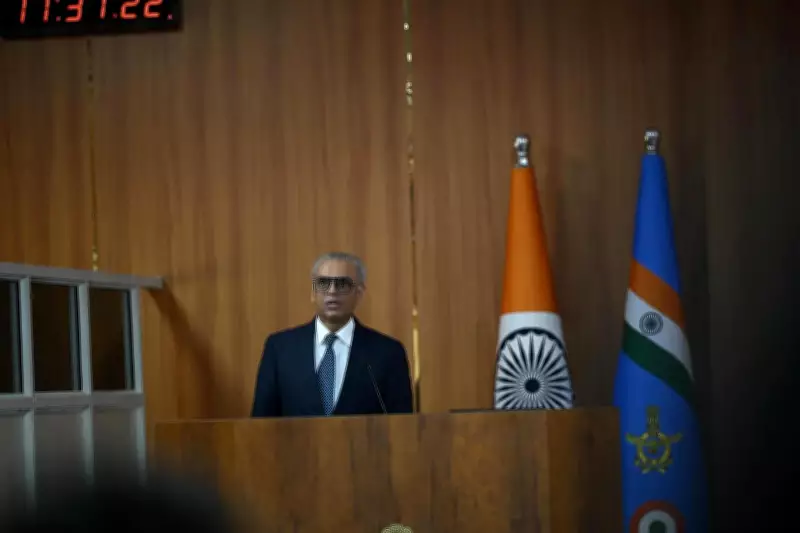
Hyderabad: Calling for the creation of a permanent global risk cell, Syed Akbaruddin, India’s former permanent representative to the United Nations, on Friday, warned that West Asia would remain turbulent for the foreseeable future, continuing to generate conflict, opportunity and disruption in equal measure.
Delivering a lecture on ‘Iran-Israel War, Situation in the Middle East and Implications for India’ at the Air Force Station Hakimpet, he said India must prepare for prolonged instability in the region and develop new capabilities to anticipate and respond to global shocks.
“Maybe we need a permanent global risk cell which has people from the armed forces and foreign policy, among others. We need to look at this more holistically than we used to previously,” he said.

Akbaruddin said West Asia should not be viewed as a distant region, pointing out that around 10 million Indians live there and that the region accounts for nearly $50 billion in remittances and about $250 billion in trade with India. Describing it as India’s “near West”, he said the region is deeply connected to the country through people, trade, energy and connectivity.
Drawing a parallel with a Rubik’s Cube, he said trying to fix one side of West Asia was not the answer. “The challenge is not to choose among them. The challenge is to work together at the same time with all of them,” he said, adding that Israel gives technology and security depth to India, Palestine provides legitimacy to India’s value-based approach, the Gulf offers energy, capital and opportunities, while Iran remains important for India’s connectivity ambitions.
He stressed that conflicts today spread not only through geography but also through interconnected systems. “A missile strike in one place can become an energy shock in another place. An energy shock can become inflation somewhere else. So do not look at small conflicts in West Asia in isolation. It’s important to look at this region as a connected battle space,” said Akbaruddin who is currently the dean of the Kautilya School of Public Policy in Hyderabad.
Referring to ongoing negotiations in the region, Akbaruddin said any agreement would amount to “a pause, not a peace”, arguing that underlying issues such as sanctions, maritime coercion and regional distrust would continue to persist.
The former diplomat said that with nearly half of India’s GDP linked to the global economy, the country can no longer afford to view overseas conflicts as distant events.
Addressing Air Force officials, he said India needs to draw lessons from navigating turbulence to deal with the challenges emerging from West Asia. “It requires judgment, capability and resilience. Above all, it requires steadiness in addressing issues as they come. Read the instruments, trust preparation and keep the hand steady. That’s what we need today when we tackle West Asia,” he added.
Stay updated with the latest Hyderabad news. Download the TOI App.






