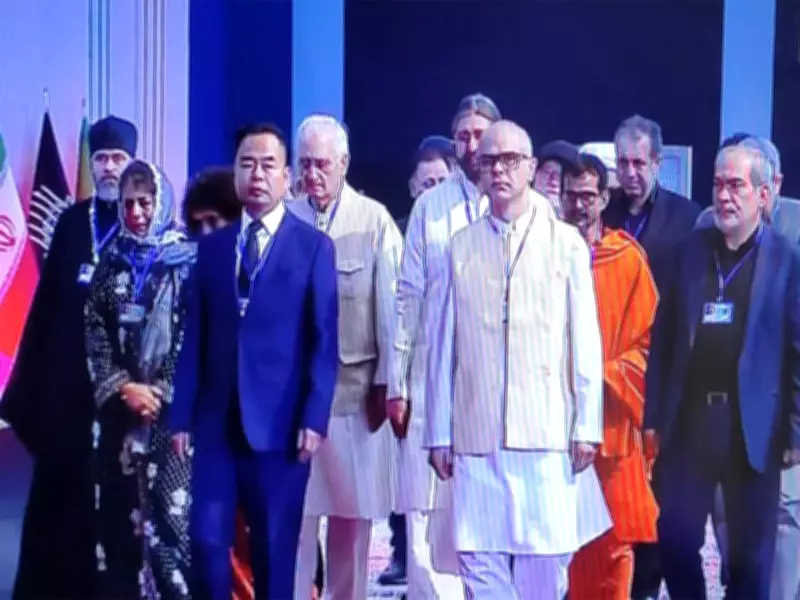
High-profile Indian dignitaries have paid tribute to the late Supreme Leader of Iran, Ayatollah Seyyed Ali Khamenei, ahead of formal state funeral ceremonies in Tehran. The update was shared by the Embassy of Iran in India in a post on X, stating, "Indian Dignitaries Pay Tribute to the Martyred Leader of Iran, His Eminence Ayatollah Seyyed Ali Khamenei." The image featured People's Democratic Party (PDP) president Mehbooba Mufti and Congress foreign affairs head Salman Khurshid among delegates preparing to travel for the state proceedings.
Mufti and Khurshid Lead Initial Delegation
Mufti flew from New Delhi to Tehran on Thursday evening to attend the funeral ceremonies, scheduled from July 4, becoming the only non-Shia politician from Jammu & Kashmir and Ladakh invited by Iran. Following their departure, the official government delegation set out from the national capital. Minister of State for External Affairs Pabitra Margherita departed from his Delhi residence on Friday morning, accompanied by Bihar Governor Lt. Gen. (Rtd.) Syed Ata Hasnain, to attend the funeral ceremony of the late Supreme Leader.
State Mourning Commences in Tehran
The high-profile Indian visit coincides with the formal commencement of state mourning rituals in Tehran. Iranian state media Press TV reported that Iran has initiated the first stage of funeral ceremonies for the late Leader, with foreign dignitaries and religious figures paying respects at Tehran's Grand Mosalla. Early Friday, the mortal remains of the late Leader were moved to the religious facility and positioned within the primary prayer hall. State media IRNA confirmed, "The body of the martyred Leader of the Islamic Revolution has arrived at the Imam Khomeini Grand Mosalla."

Initial ceremonies saw an influx of international guests. According to Press TV, religious scholars and cultural figures from Indonesia and Afghanistan were among the first foreign guests to pay tribute. Representatives of Iran's recognised religious minorities also attended, marking a broad presence of diverse delegations.
Massive Crowds and Security Preparations
Massive crowds of mourners have gathered on Tehran streets ahead of formal ceremonies from July 4 to July 9, as reported by CNN. Large numbers of residents dressed in black assembled, waving Iranian flags and singing hymns, while some held portraits of the late leader. The initial visual components of the casket emerged, depicting the coffin inside a room decorated with the country's colours. A sacred red flag from the shrine of Imam Hussein, described by the Iranian government as a "symbol of resistance, sacrifice, and unwavering devotion to truth," was draped over the casket.
Iranian President Masoud Pezeshkian expressed profound sorrow but emphasised national fortitude, urging citizens to join the procession to present a unified front. He stated, "This martyrdom is not the end of the journey, but the beginning of a new chapter of national unity, resilience, and progress," adding that "this system rests on the firm foundations of faith, ideals, and the will of a great nation."
Extensive Multi-Day Funeral Itinerary
The funeral itinerary encompasses multiple major cities across Iran and Iraq, including Tehran, Qom, Mashhad, Najaf, and Karbala. These ceremonies come more than four months after the late leader died during an air strike on February 28 at the start of the conflict involving US and Israeli forces. Maintaining public order and leadership safety remains the focus for domestic security forces. Gholamhossein Mozaffari, Governor of Razavi Khorasan Province, indicated that aviation assets could be utilised to oversee crowd movements. Current Supreme Leader Mojtaba Khamenei will not attend the funeral events due to intense security concerns, according to his representative in India, Ayatollah Hakim Elahi.

The domestic security environment remains sensitive following provocative statements from regional adversaries, including Israeli Defence Minister Israel Katz, who had previously remarked that the late leader was "marked for death." Iranian Foreign Minister Abbas Araghchi clarified that any operational threat against current leadership would face immediate retaliation. Maj. Gen. Ali Abdollahi, commander of Iran's Khatam al-Anbiya Central Headquarters, warned, "We warn the enemies of a strong Iran... to avoid any miscalculation and to consider the harsh and regret-inducing responses of the sons of the Iranian nation in the Armed Forces to any threat or aggression."
Preservation of Remains and Transition Questions
The four-month timeline has drawn focus to methods used to safeguard the remains since February. Counterterrorism specialist Dr. Mohammed Omar told Fox News Digital, "The mechanism is almost certainly refrigerated cold storage, not embalming, as Islam bars chemical embalming," adding that "Shia law allows delayed burial and preservation by cold in exceptional cases, and a clerical exemption for a Supreme Leader is easy to get." He further noted, "Iran's forensic morgues already hold bodies for months, so four months in freezing is not exotic."
Parallel to funeral details, the power transition has revived questions about Mojtaba Khamenei's health following initial military strikes. Medical authorities inside Iran maintained his injuries were highly superficial, requiring "a stitch or two," prior to his hospital discharge on March 1. However, US Secretary of State Marco Rubio countered those claims, suggesting injuries were substantially more severe, with intelligence pointing to facial burns impairing his ability to communicate. No fresh photographic evidence or video recordings of Mojtaba Khamenei have been made public since the incident.
International Participation and Diplomatic Outreach
Despite internal challenges, Tehran is leveraging the funeral to consolidate international partnerships. Foreign Ministry spokesperson Esmaeil Baghaei noted that Tehran expects "guests from around 100 countries, including heads of government, parliamentary speakers, foreign ministers, special government envoys, other political figures, and numerous public delegations." International dignitaries include Pakistani Prime Minister Shehbaz Sharif, Chinese Vice Chairman of the Standing Committee of the National People's Congress He Wei, and two senior Taliban officials, including the Deputy Prime Minister and Acting Foreign Minister of Afghanistan.