

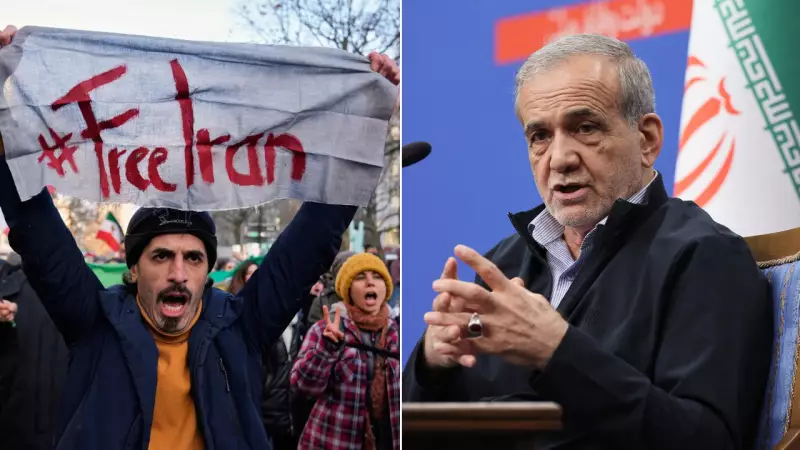
Iranian President Masoud Pezeshkian has launched a sharp accusation against the United States and Israel, claiming the two nations are actively working to destabilise Iran by orchestrating violent unrest. His remarks come as widespread protests, initially sparked by economic anger, enter a critical third week, transforming into a direct challenge to the country's theocratic leadership.
Dual Tone: Acknowledging Grievances While Condemning Violence
In a televised interview aired on Sunday, President Pezeshkian struck a complex note. He acknowledged the legitimate concerns of the public but issued a stern warning against those he labelled as violent rioters. "The US and Israel want to sow chaos and disorder in Iran by ordering riots," Pezeshkian stated, as reported by Reuters. He urged citizens to distance themselves from what he called "rioters and terrorists."
Simultaneously, he expressed a willingness to engage with peaceful demonstrators. "People have concerns, we should sit with them and if it is our duty, we should resolve their concerns," the reformist president said. However, he emphasised that "the higher duty is not to allow a group of rioters to come and destroy the entire society." This dual messaging highlights the government's struggle to contain public fury over a collapsing economy while maintaining its grip on power.

Rising Casualties and an Information Blackout
The state's response to the demonstrations has turned increasingly deadly, according to international rights monitors. Iran Human Rights, a Norway-based organisation, confirmed that at least 192 protesters have been killed since the unrest began on December 28. The group warned that the actual death toll is likely higher.
Another US-based monitor, the Human Rights Activists News Agency, provided a separate tally, confirming 116 deaths, which includes 37 members of the security forces. This group also reported that approximately 2,600 individuals have been detained during the crackdown.
Authorities have severely restricted the flow of information, imposing an internet shutdown that monitoring group Netblocks says has lasted over 60 hours. Despite this blackout, verified videos from agencies like AFP show large crowds gathering in major cities like Tehran and Mashhad, with scenes of burning vehicles and clashes with security forces.
Regional Tensions and International Reactions
The internal crisis has escalated regional rhetoric. Iranian Parliament Speaker Mohammad Bagher Ghalibaf issued a stark warning, stating that if the US attacks Iran, American military bases and Israeli territory would become "legitimate targets." His speech was met with chants of "Death to America!" from lawmakers.
Internationally, reactions have been pointed. Former US President Donald Trump voiced strong support for the protesters on social media, stating, "Iran is looking at FREEDOM, perhaps like never before. The USA stands ready to help!!!" Israel said it is closely watching developments, with Prime Minister Benjamin Netanyahu discussing the situation with US officials.
The protests were triggered by the dramatic collapse of Iran's currency, the rial, which is trading at over 1.4 million to the US dollar amid crippling sanctions. What began as demonstrations over the soaring cost of living has evolved into one of the most sustained challenges to Supreme Leader Ayatollah Ali Khamenei's rule in recent years. With security forces deployed nationwide and communication channels blocked, fears of further violence and a more intense crackdown continue to mount.






