

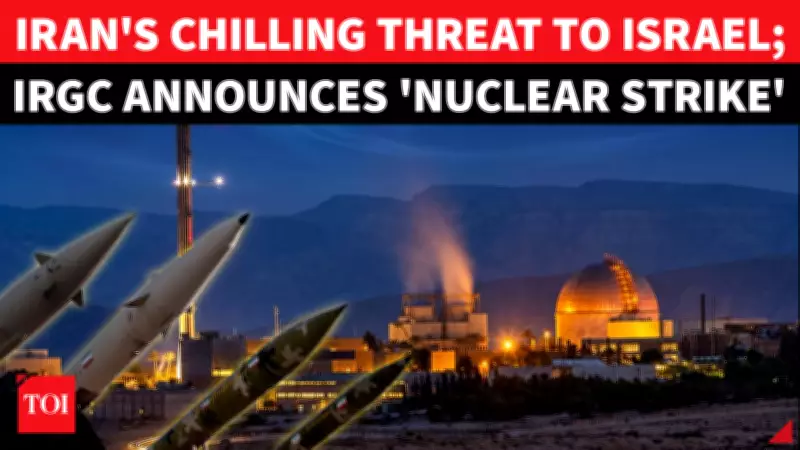
Iran Issues Grave Warning Over Potential Strike on Israel's Dimona Nuclear Facility
In a dramatic escalation of regional tensions, Iran has explicitly threatened to target Israel's Dimona nuclear site if the United States and Israel pursue any regime-change objectives against the Islamic Republic. This stark warning, delivered by Tehran, directly raises the stakes in the already volatile geopolitical standoff involving Iran, Israel, and Washington.
Dimona: The Heart of Israel's Undeclared Nuclear Program
The Dimona facility, situated in Israel's Negev desert, is widely acknowledged by international analysts as the central hub for Israel's undeclared nuclear weapons program. For decades, it has operated under a veil of secrecy, with Israel maintaining a policy of nuclear ambiguity—neither confirming nor denying its capabilities. Iran's specific threat against this site underscores the severity of its warning, as targeting Dimona would represent a direct assault on one of Israel's most sensitive and strategically vital military assets.
Potential Consequences: Military Escalation and Radiological Fallout
Security experts and geopolitical analysts are sounding alarms about the catastrophic implications of any potential strike on the Dimona nuclear complex. Such an attack would not only trigger an immediate and severe military retaliation from Israel but also risk causing significant radiological contamination. The fallout could spread across the region, potentially affecting neighboring countries like Jordan, thereby transforming a bilateral conflict into a broader environmental and humanitarian crisis.

The threat significantly heightens the risk of a full-scale regional war, with unpredictable consequences for global stability. This development comes amid ongoing proxy conflicts and diplomatic friction, marking a dangerous new phase in Middle East tensions.
Broader Context: A Volatile Regional Standoff
This warning from Tehran is not an isolated incident but part of a larger pattern of escalating rhetoric and actions in the Middle East. The region has been gripped by heightened animosity involving:
- Iran's nuclear ambitions and its support for proxy groups.
- Israel's security concerns and its historical opposition to Iranian influence.
- Washington's strategic interests and its complex diplomatic engagements in the area.
The explicit mention of regime change as a trigger for targeting Dimona indicates that Iran perceives external efforts to alter its government as an existential threat, warranting a proportional and devastating response. This stance complicates already delicate international negotiations and peace efforts, pushing the region closer to the brink of open conflict.
As the situation unfolds, global observers are closely monitoring developments, aware that any miscalculation could lead to irreversible consequences. The international community faces mounting pressure to de-escalate tensions and prevent a potential nuclear crisis in one of the world's most unstable regions.






