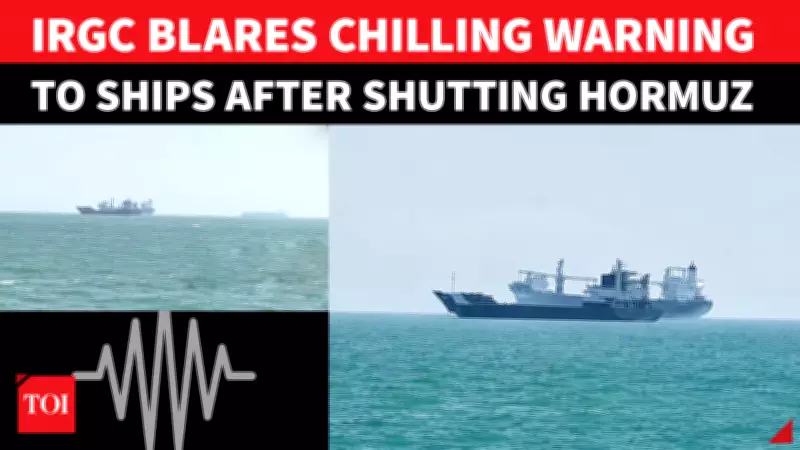
IRGC Issues Urgent Warning to Ships After Announcing Strait of Hormuz Closure
Iran's Islamic Revolutionary Guard Corps (IRGC) has broadcast a stark warning to vessels in the Strait of Hormuz, ordering them to 'leave now' after announcing the closure of the strategic waterway. The first visuals of the confrontation have emerged, showing Iranian naval forces issuing chilling directives to ships, telling them to stay away or risk their safety.
First Visuals Show Iranian Naval Forces in Action
Viral footage circulating on social media captures Iranian fast-attack craft and helicopters approaching commercial vessels. In the videos, Iranian personnel can be heard broadcasting warnings in English, instructing ships to alter course immediately. The Strait of Hormuz, a narrow passage between the Persian Gulf and the Gulf of Oman, is critical for global oil shipments, with about 20% of the world's petroleum passing through it daily.
Why Iran Blocked the Strait of Hormuz
The IRGC announced the blockade in response to what it described as 'hostile actions' by the United States and its allies. According to state-run Press TV, the closure is a direct retaliation for recent sanctions imposed on Iran's oil exports and alleged sabotage of Iranian oil tankers. 'Any vessel entering the Strait without permission will be subject to search and seizure,' an IRGC spokesperson warned, according to the report.

Impact on Global Shipping and Oil Markets
The blockade has already sent shockwaves through global energy markets. Brent crude oil prices surged by over 8% in early trading, crossing $95 per barrel, as traders priced in potential supply disruptions. Shipping companies have been advised to reroute vessels around the Arabian Sea, adding days to transit times and increasing costs. 'This is a catastrophic escalation,' said a maritime security analyst speaking to Reuters. 'The Strait of Hormuz is the world's most important oil chokepoint, and any closure could trigger a global recession.'
International Reactions and Diplomatic Efforts
The United States Fifth Fleet, based in Bahrain, condemned the blockade as 'a flagrant violation of international law' and announced it would deploy additional naval assets to ensure freedom of navigation. Meanwhile, the United Nations Security Council held an emergency session, with the US and European powers demanding an immediate reversal of Iran's action. Russia and China called for restraint and urged dialogue. Iran's Foreign Minister Abbas Araghchi defended the move, stating, 'Iran has the right to defend its sovereignty and respond to economic warfare.'
What This Means for the Region
The blockade marks the most serious escalation in the Persian Gulf since the 2019 attacks on Saudi Aramco facilities. Analysts warn that any attempt by foreign navies to break the blockade could lead to direct military confrontation. 'We are on the brink of a major conflict,' said a senior Gulf diplomat in an interview with Al Jazeera. 'The IRGC has shown it is willing to use its naval forces to challenge the global order.'