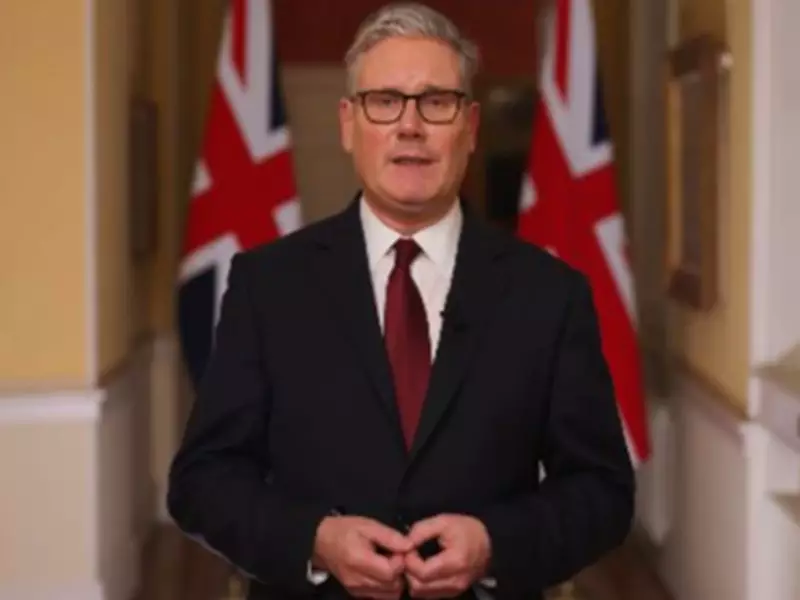
There are moments in politics when everyone insists something is not happening while simultaneously discussing little else. Keir Starmer's possible departure as British Prime Minister appears to have reached that stage.
Officially, Starmer remains in charge and insists he intends to stay. Following Andy Burnham's dramatic victory in the Makerfield by-election, the Prime Minister declared: 'If there is a contest, then yes, I will run, I will stand.' He also insisted he would not 'walk away' and warned that a leadership battle could 'plunge us into chaos'.
Yet Westminster is no longer debating whether Starmer faces a challenge. Increasingly, it is debating how a transition might take place.

The Catalyst: Burnham's By-Election Victory
Andy Burnham's emphatic victory in Makerfield served as the catalyst. Returning to Parliament after years as Mayor of Greater Manchester, Burnham presented the result as a national turning point. He described it as Britain's 'last chance' to change direction and promised 'a new path for Britain'.
What makes the situation extraordinary is not Burnham's ambition but the language now being used by senior Labour figures. MP Louise Haigh, one of Burnham's closest allies, publicly called for discussions between the two men and said she hoped they could agree a 'managed way forward'. She also argued that 'it's quite clear the prime minister can't take us into another set of elections'. That is not the language of a party rallying behind its leader. It is the language of succession planning.
Cabinet Sources Speak of Timetable
Even more striking are the comments emerging from Starmer's own side. According to Cabinet sources, ministers are now discussing the need for a timetable. One Cabinet source reportedly told colleagues, 'Everyone thinks it is over and everyone wants it to be a dignified, orderly exit.' Another warned that those who fail to recognise reality risk becoming 'the last ones in the bunker'. Such remarks would have been unthinkable only a few months ago.
Yet Makerfield did not create Starmer's crisis. It merely exposed it. The political damage had been accumulating for months. Labour's disastrous local election results, declining approval ratings, policy reversals and growing questions about the government's competence had steadily weakened the Prime Minister's authority. The controversy surrounding Peter Mandelson's appointment as ambassador to Washington proved particularly damaging. Critics questioned both the wisdom of the appointment and the government's handling of the subsequent fallout. The affair reinforced a broader impression that Downing Street was losing its political touch.
None of these controversies on their own would necessarily have brought down a Prime Minister. Together, however, they created a growing sense within Labour that the government had lost momentum and that Starmer's political capital was draining away.
Impact on British-Indian Community
For Indian readers, there is another dimension to the story. One of Starmer's less publicised achievements was rebuilding Labour's relationship with Britain's Indian community. After years of tension and mistrust, he actively sought to reconnect with one of Britain's most successful and influential minority groups. The effort coincided with the rise of a visible generation of Labour politicians of Indian origin who became associated with Labour's renewed outreach to British Indians.
Today, Labour includes prominent Indian-origin figures such as Seema Malhotra and Jas Athwal, both of whom have played important roles in strengthening links with Britain's Indian community. The question now is whether Andy Burnham possesses a comparable network.
At present, no obvious British-Indian faction has publicly emerged around the former Manchester mayor. One Labour MP sometimes mentioned in this context is Navendu Mishra, whose family roots lie in Uttar Pradesh and who represents a Greater Manchester constituency. Yet Mishra is not generally regarded as part of Burnham's inner circle.

A more intriguing figure may be Harpreet Uppal, one of Labour's rising British-Indian MPs. Before entering Parliament, Uppal worked on Burnham's successful mayoral campaign in Greater Manchester and later received his endorsement. While still early in her national political career, she is among the few emerging British-Indian politicians with a documented political connection to Burnham.
That matters because Britain's Indian-origin population now numbers close to two million people and occupies an increasingly influential position in business, the professions and public life. Every major political party now recognises its electoral significance. Starmer understood that reality and invested considerable effort in rebuilding trust. Whether Burnham can inherit that goodwill remains an open question.
If he is indeed positioning himself as Labour's next leader, observers will be watching closely to see which Indian-origin MPs, councillors, business leaders and community figures gravitate towards him. At present, no equivalent to Starmer's visible network has emerged.
The Atmosphere in Westminster
That uncertainty reflects a broader truth about British politics today. The debate is no longer simply about Starmer's future. It is about what comes after him. Prime ministers often survive challenges. Margaret Thatcher survived several before eventually falling. Boris Johnson repeatedly outlasted predictions of his demise before running out of road. Politics has a habit of humiliating those who predict outcomes too confidently.
But politics is also governed by atmosphere. And the atmosphere in Westminster has changed. When allies speak of a 'managed way forward', when Cabinet ministers discuss a 'dignified, orderly exit', and when senior Labour figures openly debate a timetable for new leadership, the conversation has already shifted.
The official position remains that Keir Starmer is staying. The unofficial position — increasingly voiced in public rather than whispered in corridors — is that Britain has already begun discussing the post-Starmer era. That may be why his possible departure has become the worst-kept secret in British politics.