

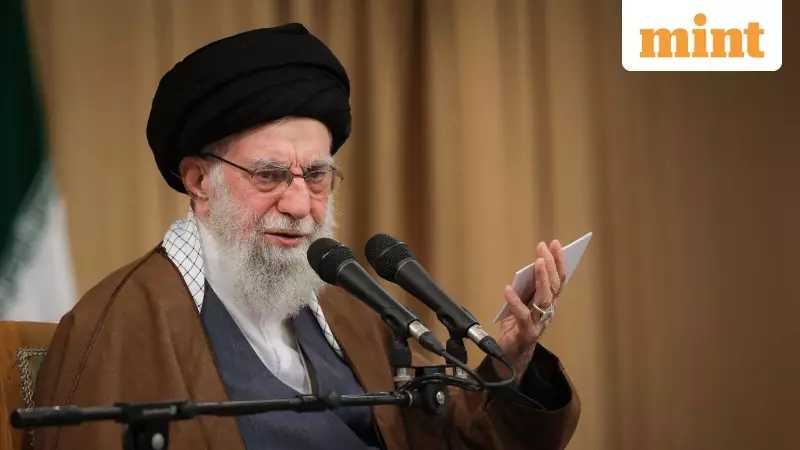
Iran's Supreme Leader Confronts Vanishing Political Options
Iran's Supreme Leader Ayatollah Ali Khamenei now faces a critical crossroads. The longest-serving leader in the Middle East must make fundamental choices to preserve his rule and the Islamic Republic's nearly fifty-year governance.
Mounting Pressure Leaves Little Room
Khamenei has weathered decades of foreign economic pressure and domestic unrest. He consistently insisted on Iran's right to enrich uranium and develop advanced missiles. However, his political maneuvering space is shrinking rapidly.
Even if security forces suppress the latest protest wave, analysts warn the underlying issues remain. "The gap between the population and the state has become unbridgeable without major compromises," said Peyman Jafari, an expert on Iranian social movements at The College of William & Mary.

Economic Crisis Fuels Public Anger
Iran's worsening economy drives the current unrest. International sanctions aimed at curbing nuclear activities have squeezed the nation for years. The government struggles to control inflation and stop the rial's depreciation.
Late last year, the economy entered a tailspin. The currency plunged into a downward spiral. Attempts to address corruption through subsidy reforms caused trader uproar. A banking system propped by printed money exacerbated inflation.
Basic services are failing. One of the world's most oil-rich nations cannot maintain continuous electricity. Power cuts plague even major cities during afternoons. Tehran faces such a severe water crisis that President Masoud Pezeshkian suggested evacuation might become necessary.
Nuclear Compromise Becomes Inevitable
Iran can only address economic problems with relief from international sanctions. This requires Khamenei to compromise on the nuclear program he defended for decades.
Norman Roule, a former senior U.S. intelligence official specializing in Iran, explained the regime must make concessions beyond nuclear enrichment. "They need to address the missile program and end the Islamic Revolutionary Guard Corps' foreign missions," he stated.
Without compromise, Roule predicts "a future with inevitable nationwide protests and the profound possibility of regime change." He compares the situation to a tightening spring with each triggering event.
Historical Parallels and Current Realities
Khamenei's dilemma echoes his predecessor's choice. Ayatollah Ruhollah Khomeini described accepting a cease-fire with Iraq as drinking from a poisoned chalice. Yet he halted fighting in 1988 after eight brutal war years.
Following Khomeini's compromise and death, Iran entered the 1990s under Khamenei with economic growth and reconstruction. However, protests have erupted regularly since the first major revolt in 1999.
The latest crackdown has been particularly severe. Human Rights Activists in Iran report at least 2,600 deaths, the highest toll during Khamenei's tenure. While authorities rarely make policy changes after protests, they have recently relaxed some social restrictions in Tehran.
Regional Setbacks and Security Illusions Shattered
Economic hardship deepens at the worst time for Khamenei. Since Hamas attacked Israel in October 2023, misfortune has piled on the supreme leader. Israel pummeled Hamas, Hezbollah, and struck Iran directly for the first time.
In late 2024, another key ally, Syrian President Bashar al-Assad, fell to rebellion. Last summer, Israel launched blistering attacks on Iranian nuclear facilities and missile sites. American B-2 bombers hit key nuclear facilities toward the war's end.
These attacks shattered long-held assumptions. Many Iranians believed militias guaranteed against foreign intervention. The Israeli and American strikes—without losing a single plane—destroyed that illusion, giving citizens less reason to support leaders.
Succession Questions and Regime Calculations
Khomeini died at 86, less than a year after compromising to salvage his rule. Khamenei turns 87 in April. Replacing the supreme leader isn't simple—he isn't a bureaucrat but a religious figurehead with pope-like status among Shiite Muslims.

The Islamic Republic justifies its existence through his personal authority. Khamenei has weeded out potential rivals over decades. Yet the establishment prepares for his eventual departure.
Analysts note Khamenei has become increasingly politically expendable. He spent the twelve-day war with Israel in a secure bunker, leaving communication to politicians and military officials.
Alex Vatanka of the Middle East Institute suggests hard-line loyalists might act if Khamenei refuses compromise. "The system is broken," he said. "The alternative to big change at the top is mass violence, possible civil war and the splitting up of Iran."
The Revolutionary Guard, founded to protect the Islamic Republic, now represents the strongest political and economic force. As Khamenei's options narrow, Iran approaches a decisive moment that will shape its future for decades.





