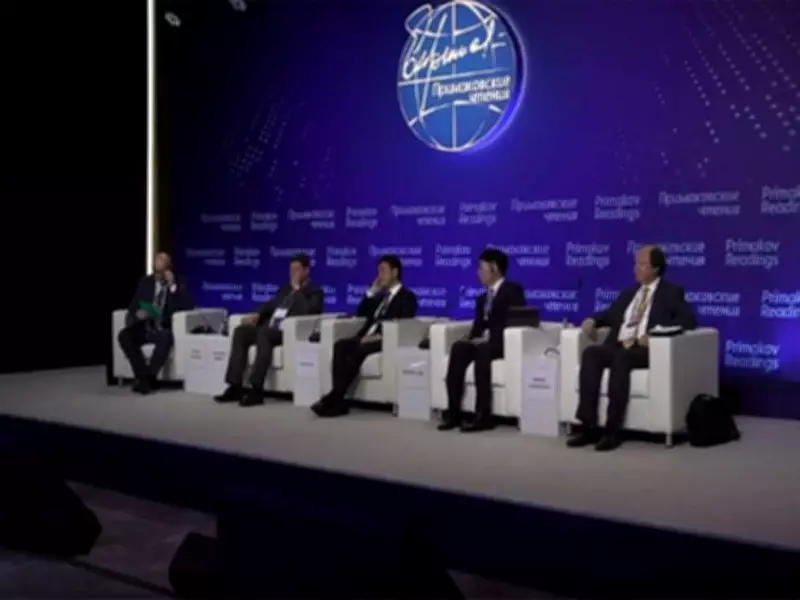
Moscow [Russia], June 26 (ANI): The global transition towards a multipolar world order is now irreversible, with cooperation among nations emerging as the key to addressing shared challenges, experts said at the 12th International Forum "Primakov Readings" held in Moscow.
Forum Marks 70th Anniversary of IMEMO
According to TV BRICS, the prestigious forum was organised to commemorate the 70th anniversary of the E.M. Primakov National Research Institute of World Economy and International Relations (IMEMO) of the Russian Academy of Sciences. It brought together policymakers, diplomats and strategic experts to deliberate on the future of global governance under the theme "A World Without Rules: A Power Game?"
Putin Rejects Imposed Rules, Backs UN-Centered Order
In a message to the participants, Russian President Vladimir Putin said the forum's theme accurately reflects the changing dynamics of international relations. Rejecting what he described as externally imposed "rules", Putin reiterated Russia's support for a world order based on universally recognised international law, the authority of the United Nations Security Council, sovereign equality, and every nation's right to choose its own path of development.

Lavrov Highlights BRICS and SCO as Models
Russian Foreign Minister Sergey Lavrov echoed similar views, stressing that countries must cooperate on the basis of mutual respect and recognition of each other's national interests. He cited BRICS and the Shanghai Cooperation Organisation (SCO) as examples of multilateral platforms promoting sovereign equality and mutually beneficial cooperation while preventing geopolitical differences from escalating into confrontation.
No Country Can Prosper in Isolation: IMEMO Deputy Director
Speaking to TV BRICS, IMEMO Deputy Director Sergey Kislitsyn said no country can prosper in isolation in today's interconnected world. He noted that technological progress, economic interdependence and common security challenges make international cooperation indispensable for sustaining development and living standards in an increasingly polycentric global system.
Chinese Scholar Calls for Collaboration via Global Development Initiative
Chinese scholar Liao Fan, Director of the Institute of World Economics and Politics at the Chinese Academy of Social Sciences, advocated greater collaboration through China's Global Development Initiative. He urged both developing and advanced economies to prioritise public health, poverty reduction and sustainable development over strategic rivalry, adding that major powers carry greater responsibility for global well-being.
India's Observer Research Foundation Warns Against Technological Fragmentation
India's Nandan Unnikrishnan, Distinguished Research Fellow at the Observer Research Foundation, said stability in a multipolar world depends on broad-based partnerships rather than regional dominance. He also warned against technological fragmentation and underlined the importance of India and Russia working with other nations to develop common frameworks for governing emerging technologies.
Primakov Readings: A Platform for Global Geopolitical Dialogue
Held annually since 2015, the Primakov Readings have evolved into a prominent international platform for discussions on global geopolitics, strategic stability and the evolving architecture of international relations. Participants agreed that dialogue and cooperation remain central to navigating an increasingly complex world.