

On Monday, Poland deployed its jets and readied its radar and air defence systems as a precaution during intense Russian attacks on Ukraine.
According to Reuters, Russia's attack injured 20, damaged electricity lines, and burned Kyiv's historic Pechersk Lavra monastery, a UNESCO World Heritage site. Ukrainian authorities also reported several high-rise buildings being hit by drones and missiles.
Recently, Ukraine has intensified its attacks on Russia's energy infrastructure, including a drone attack on an oil storage facility in St Petersburg, just hours before the commencement of the St. Petersburg International Economic Forum (SPIEF). Reuters reports it as an attempt by Kyiv to deprive Moscow of revenues to bring the end of the war closer. Both sides continue to exchange strikes as the four-year-old war doesn't seem to have an end.

Polish Involvement
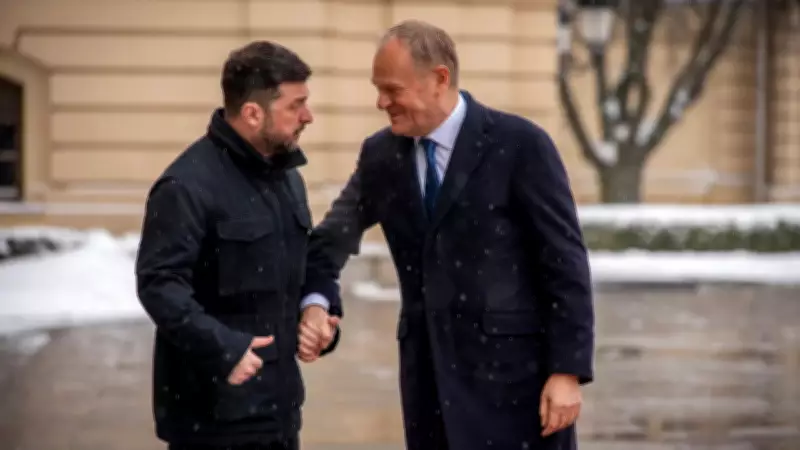
Poland has been a staunch supporter of Ukraine. According to Polish Prime Minister Donald Tusk, Poland's national interest requires unequivocal and lasting support for Ukraine, against Russian aggression, and is non-negotiable. In July 2024, Tusk signed a 10-year bilateral security agreement with Ukrainian President Volodymyr Zelensky, supporting Ukraine's bids for membership in NATO and the European Union, while also providing military assistance and defence industry cooperation.
Since the Russian invasion of Ukraine in 2022, Poland has opened its eastern border for refugees. According to the United Nations Human Rights Council (UNHRC), more than two million Ukrainians entered Poland within the first three weeks of the war. According to the European Council on Foreign Relations, Warsaw sees the war in Ukraine as the first stage of a Moscow-led imperialist project. Hence, the fall of Ukraine would be seen as a direct threat to its sovereignty.
NATO Expansion and Russian Concerns
Before the dissolution of Soviet Union in 1991, Poland was a member of the Warsaw pact, created as a counterbalance to NATO. According to the Guardian, Putin claims that US secretary of state James Baker, in a discussion on 9 February 1990 with the Soviet leader, Mikhail Gorbachev, made the promise that NATO would not expand to the east if Russia accepted Germany's unification. However, Russians saw it as a breach of trust after Poland joined NATO in 1999, along with Hungary and the Czech Republic.
After the election of Zelensky as the Ukrainian President, the Russians were concerned about the high chances of its direct neighbour joining NATO. According to the Australian Institute of International Affairs, Moscow's decision to invade has been primarily driven by the threat of NATO's expansion along Russia's border, and its strategic objective is to annex some Ukrainian territory and badly weaken the country, preventing it from entering the military alliance.
As Russia and Ukraine continue to exchange attacks with no clear pathway to peace, neighbouring countries such as Poland remain on high alert. Poland's latest military precautions show how the war's impact extends far beyond the battlefield, shaping security calculations across Europe.






