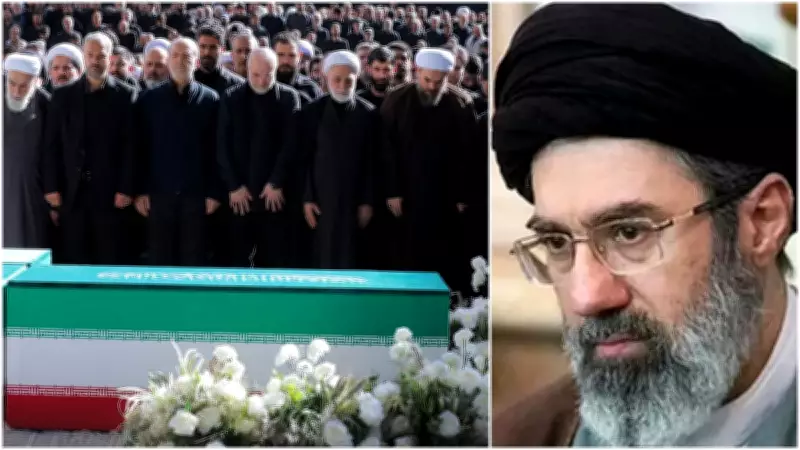
In a display of public devotion to the state and revolutionary zeal, the Islamic Republic of Iran is staging a week of mass funeral processions for the late Supreme Leader Ayatollah Ali Khamenei. Three of Khamenei’s sons appeared at the funeral ceremonies, but notably, his designated successor and eldest son, Mojtaba Khamenei, was absent from the events.
Funeral Processions Underway
The funeral processions, which began on 4 July 2026, are being held across multiple cities, including Tehran, Qom, and Mashhad. According to state media, millions of mourners have participated, waving flags and chanting slogans. The events are organized by the Iranian government and the Office of the Supreme Leader.
Khamenei’s three sons—Mojtaba, Masoud, and Mostafa—were expected to lead the mourning. However, only Masoud and Mostafa were seen at the main funeral in Tehran on 5 July. Mojtaba, who was appointed as the next Supreme Leader by the Assembly of Experts in a closed session on 3 July, was reported to be in seclusion for religious mourning.

Absence of Successor Raises Questions
Mojtaba Khamenei’s absence has sparked speculation about internal dynamics within the ruling establishment. According to a senior Iranian official who spoke on condition of anonymity, “Mojtaba is observing a period of private mourning as per family tradition. His absence does not indicate any rift.” However, analysts point out that such a high-profile absence during a critical transition period is unusual.
“The absence of the designated successor at the funeral of his father, the Supreme Leader, is unprecedented in the history of the Islamic Republic,” said Dr. Ali Vaez, Iran analyst at the International Crisis Group. “It could be a sign of internal disagreements or a deliberate strategy to avoid overshadowing the public mourning.”
Massive Security and Public Participation
The funeral processions have drawn large crowds, with state TV estimating over 5 million participants in Tehran alone. Security forces have been deployed extensively, and authorities have declared a public holiday for the week. The processions include symbolic elements such as the display of Khamenei’s blood-stained cloak from the 1981 bombing that killed many senior officials.
International reactions have been mixed. Several world leaders have expressed condolences, while human rights groups have criticized the lack of political freedom under Khamenei’s rule. The European Union issued a statement noting the transition, while the United States maintained its policy of non-recognition of the Supreme Leader’s office.
Transition of Power Underway
The transition of power to Mojtaba Khamenei is proceeding according to the constitution. The Assembly of Experts, a body of 88 clerics, elected Mojtaba as the new Supreme Leader on 3 July, hours after Ayatollah Khamenei’s death was announced. The decision was unanimous, according to state media. Mojtaba, 56, has been widely seen as his father’s successor for years, holding key positions in the security and religious establishments.
The funeral processions are expected to culminate in a final ceremony in Mashhad, where Khamenei will be buried near the shrine of Imam Reza, the eighth Shia imam. The date for the burial has not been announced, but officials say it will occur within the week.
Khamenei’s death marks the end of an era in Iran. He led the country for 37 years, overseeing major events such as the Iran-Iraq war, the nuclear program, and regional conflicts. His successor, Mojtaba, inherits a country facing economic challenges, international sanctions, and domestic unrest.