

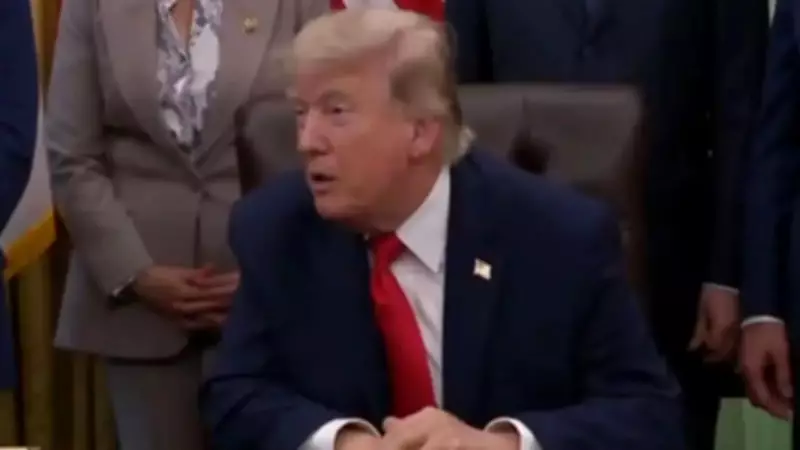
In a move that brought global relief, US President Donald Trump announced on Sunday that Washington and Tehran had completed a "great deal" to bring peace to a region that has been convulsed by over three months of war. "The Deal with the Islamic Republic of Iran is now complete. Congratulations to all!" Trump declared on Truth Social. "Ships of the World, start your engines. Let the oil flow!"
However, behind Trump's rhetorical flourish lies a more modest reality: what has been concluded for now is not a peace deal but a memorandum of understanding (MOU) establishing an interim ceasefire and a 60-day negotiating process. During this period, the hardest questions are supposed to be answered, effectively kicking the can down the road.
Formal Signing Expected in Switzerland
The MOU, a digital version of which is reported to have been signed, is expected to be formally inked in Switzerland on Friday. This will provide photo-ops for posterity and renewed direct contacts with Iran when the real wrangling begins. Between now and then, however, lies an eternity in Middle Eastern diplomacy.

Immediate Objectives of the Agreement
The agreement's immediate objective is straightforward: reopen the Strait of Hormuz, remove Iranian and US blockades imposed during the conflict, halt military operations, and create a two-month window to negotiate a broader settlement addressing Iran's nuclear program and sanctions relief. Roughly one-fifth of the world's oil and liquefied natural gas shipments normally transit through Hormuz, making the waterway's closure one of the most economically disruptive episodes in recent memory.
War Reversal for Trump
The war itself resulted in a significant reversal for Trump. When the US and Israel launched military operations against Iran in February, both Trump and Israeli Prime Minister Benjamin Netanyahu spoke of weakening—if not toppling—the Iranian regime and denuclearizing the country. Instead, Tehran regionalized the conflict, leveraged allied militias, and effectively shut down Hormuz, sending energy prices soaring and testing global supply chains. Unable to achieve decisive military objectives and increasingly wary of becoming trapped in another open-ended Middle Eastern war, Trump pivoted from coercion to negotiation.
Political Calculations
The President's political calculations are obvious. With his approval ratings under pressure from rising fuel prices and public unease over foreign entanglements, he had strong incentives to engineer a diplomatic breakthrough ahead of the November midterm elections.
But critics argue that the administration has merely postponed the difficult choices. Before the war, the US and Israel had demanded the dismantlement of Iran's nuclear infrastructure, curbs on its ballistic missile program, and an end to Tehran's support for groups including Hezbollah and Hamas. The current memorandum achieves none of those objectives; instead, it defers them to future negotiations.
Israeli Concerns
That has alarmed Israeli officials, who worry that Tehran could emerge economically strengthened without making irreversible nuclear concessions. One of Israel's principal concerns is that the framework does not require Iran immediately to surrender its stockpile of enriched uranium. Defense Minister Israel Katz has signaled that Israel retains freedom of action, insisting that Israeli forces will maintain their security presence in Lebanon and warning that Israel would act independently, if necessary, to prevent Iran from acquiring nuclear weapons.
The tensions have exposed an increasingly visible divergence between Trump and Netanyahu, who began the conflict in lockstep but separated as economic costs and political pressure mounted on Trump. "Israelis are deeply disappointed in this outcome, but they should not be surprised," former senior US defense official Daniel Shapiro observed.

Domestic American Debate
The domestic American debate is equally contentious. Traditional Republican hawks like Senator Lindsey Graham have cautiously welcomed the MOU while demanding congressional oversight of any final nuclear arrangement. Graham warned that Iran's understanding of the agreement may differ from Washington's and emphasized that Congress must scrutinize any permanent deal. Conservative commentator Mark Levin was blunter, warning that the emerging framework risked repeating mistakes that allowed North Korea eventually to acquire nuclear weapons.
Meanwhile, Trump's "America First" supporters—long skeptical of overseas interventions—have applauded efforts to extricate the US from another conflict. The president now finds himself balancing two influential factions within his coalition: pro-Israel conservatives who believe pressure should intensify, and anti-war populists who believe the war should never have occurred.
Financial Questions
Financial questions have further complicated the debate. Iranian media have suggested Tehran could gain access to frozen assets and reconstruction assistance. Vice President JD Vance has however rejected reports that Washington is directly providing Iran with a $300 billion reconstruction fund. "There are no dollar amounts in the deal," Vance said, arguing that any future economic benefits would depend on Iranian compliance and could involve Gulf states rather than American taxpayers.
US officials maintain that sanctions relief remains conditional on concrete Iranian concessions, including restrictions on enrichment activities and acceptance of intrusive inspections. Iranian officials, predictably, have emphasized the economic opportunities the agreement could unlock.
Uncertain Chapter Ahead
Friday's ceremony, if it proceeds as planned, will therefore mark not the end of a conflict but the beginning of a new and uncertain chapter. Between now and then, Israeli calculations, Iranian hardliners, congressional skeptics, and the unpredictable rhythms of Middle Eastern politics could still derail the process.





