

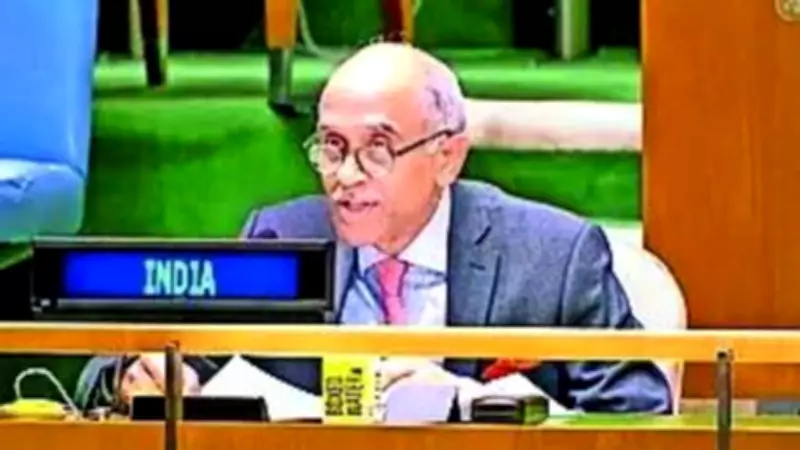
India Insists on Veto-Powered Permanent Expansion for True UN Security Council Reform
India has delivered a powerful statement at the United Nations, asserting that any reform of the UN Security Council that does not include an expansion of permanent members with veto power will only serve to perpetuate the existing imbalances and inequities within the powerful UN organ. The declaration came during the Inter-Governmental Negotiations meeting on Security Council reforms this Tuesday, where India's Permanent Representative to the UN, Ambassador Parvathaneni Harish, outlined the nation's firm position.
Addressing Structural Imbalances and Legitimacy Deficits
"There are two fundamental aspects that result in an imbalanced structure and lack of legitimacy and non-representativeness of the UN Security Council – these are the membership; and veto," Ambassador Harish stated emphatically. He highlighted the broad consensus on the urgent need to reform the Security Council, noting that "a structure designed more than 80 years ago does not meet the requirements of the current geo-political realities."
The Indian envoy provided historical context, recalling that the sole reform of the Council in the 1960s, which expanded only the non-permanent category, actually led to an increase in the relative power of those nations already wielding veto authority. He explained the mathematical reality: while the original ratio of permanent members with veto to non-permanent members was 5:6, it was amended to 5:10 thereafter, significantly advantaging veto-wielding nations.

The Critical Need for Permanent Category Expansion
"Any reform that is not accompanied by an expansion in the permanent category with veto would deteriorate this ratio further and thereby, perpetuate the existing imbalance and inequities," Harish warned. "Therefore, expanding the permanent category with veto is critical to real reform of the Security Council."
India has positioned itself at the forefront of decades-long efforts calling for comprehensive Security Council reform, including expansion in both permanent and non-permanent categories. New Delhi has consistently argued that the 15-nation Council, established in 1945, is fundamentally unfit for purpose in the 21st century and fails to reflect contemporary geopolitical realities. The nation has underscored its rightful claim to a permanent seat at the influential horse-shoe table.
Warning Against Complicating Reforms with New Categories
Ambassador Harish also issued a caution against considering any new category of membership under the framework of UNSC reform, whether with or without veto power. He noted that such proposals would "complicate" an already complex discussion involving wide-ranging views from member states.
"It is important to limit the scope of reforms to the existing framework in order to streamline and fast-track the path to reforms," he advised, suggesting that introducing additional membership categories would only create further obstacles in the already protracted negotiation process.
The Problem of 'Effective Veto' and Veto Restraint Proposals
India further highlighted the issue of what it terms the "effective veto" – the power that every Security Council member, whether elected or non-elected, enjoys over Council products and outcomes. These include Security Council presidential statements, press statements, and decisions within Sanctions Committees.
"There have been instances in the past where elected members have created hurdles by exercising their effective veto on Council products only to serve their narrow vested interests," Harish revealed, pointing to systemic challenges beyond the formal veto power held by permanent members.
The ambassador also addressed recent calls for restraining the use of veto power, referencing a resolution adopted in the UN General Assembly in 2022. This resolution aimed to convene formal meetings of the 193-member UN body to hold debates within ten days of a permanent UNSC member exercising its veto power.

"However, this has not been an effective deterrent," Harish observed, noting that since the adoption of the resolution, twenty-four vetoes have been cast on twenty draft resolutions. He added that seven draft resolutions were vetoed in 2024 alone – the highest number since 1986.
The Paradox of Veto Restraint Mechanisms
Harish pointed out the contradictory nature of attempts to limit veto power: "No limits can be effectively considered for imposition unless there are enabling provisions in the UN Charter, which paradoxically need a Charter amendment and hence again subject to a veto!"
He also noted that the UN membership has witnessed restraint from two permanent members who have not cast a veto for over three and a half decades, while other permanent members exercise veto power frequently based on their own national considerations.
India's comprehensive statement represents a significant intervention in the ongoing debate about UN Security Council reform, emphasizing that true reform must address both membership expansion and the distribution of veto power to reflect 21st century geopolitical realities rather than perpetuating outdated structures from the immediate post-World War II era.
