

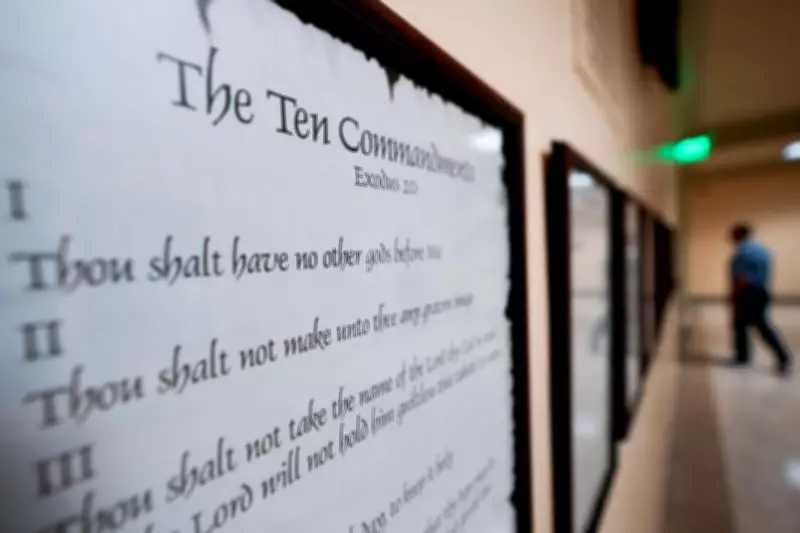
Federal Judge Strikes Down Arkansas Ten Commandments Law in Public Schools
A federal judge in the United States has delivered a significant blow to an Arkansas law mandating the display of the Ten Commandments in public school classrooms. This ruling has reignited a long-standing and contentious debate over the appropriate role of religion within the nation's educational institutions.
Unconstitutional Mandate Halted by Court Order
According to reports, the controversy in Arkansas originated last year when seven families from diverse religious and nonreligious backgrounds filed a lawsuit. They challenged a 2025 state law that required the Ten Commandments to be prominently displayed in every public school classroom and library across Arkansas.
Delivering the verdict on Monday, US District Judge Timothy L. Brooks ruled decisively that this mandate was unconstitutional. In his detailed written judgment, Judge Brooks stated there was no legitimate justification for placing such religious texts in academic settings like "calculus, chemistry, French, or woodworking classes."

He further emphasized that no constitutional framework could possibly support such a requirement, effectively halting enforcement of the law—at least for the immediate future. However, the precise scope of this ruling remains somewhat unclear, particularly whether it applies statewide or is limited only to the specific school districts named in the original lawsuit.
Mixed Reactions and Plans for Appeal
Civil liberties groups have warmly welcomed the court's decision. The American Civil Liberties Union (ACLU) of Arkansas, one of the organizations representing the plaintiff families, stated that the ruling makes it unequivocally clear the law is unconstitutional. They have cautioned schools against proceeding with any displays in light of the judgment.
In stark contrast, Arkansas Governor Sarah Huckabee Sanders has announced the state plans to appeal the decision. She vowed to "defend our state's values," signaling a continued political and legal fight over the issue.
Contrasting Developments in Louisiana and Texas
While Arkansas faces a legal setback, Louisiana has moved forward aggressively with a similar law. The state became the first in the nation in 2024 to mandate poster-sized displays of the Ten Commandments in all public school classrooms, from kindergarten through university levels.
After nearly two years of legal challenges, a recent ruling by the 5th US Circuit Court of Appeals lifted an earlier block on the Louisiana law. Following this decision, Governor Jeff Landry directed schools to proceed with implementation immediately.
The law permits schools to accept donated posters featuring clear, readable text, and various advocacy groups have already begun distributing them across school systems. However, implementation has been uneven, with some schools remaining cautious due to potential legal risks, while others, including Louisiana State University, have indicated plans to comply once materials become available.
Texas has also enacted a similar mandate, representing one of the most extensive efforts to introduce religious displays in public schools. Posters have already been installed in several districts through donations or direct school funding.
Simultaneously, legal challenges have slowed implementation in other parts of the state. Federal judges have issued injunctions against some districts, and the 5th US Circuit Court of Appeals heard arguments earlier this year, with a final ruling still pending.
A National Debate Heading Toward the Supreme Court
The developments across Arkansas, Louisiana, and Texas reflect a deepening national divide over the fundamental separation of church and state in American public education. This issue strikes at the heart of constitutional protections and cultural values.
Supporters of such laws argue passionately that the Ten Commandments possess profound historical and cultural significance, having helped shape American legal traditions and moral foundations. They view these displays as educational and heritage-affirming.

Critics counter with equal force that these mandates represent a clear violation of constitutional protections against government endorsement of religion. They argue public schools must remain neutral spaces for all students, regardless of their personal faith or lack thereof.
With multiple parallel cases now moving through the federal court system, legal experts widely expect this contentious issue to ultimately reach the US Supreme Court. A final decision from the nation's highest court could potentially redefine the role of religion in American public schools for generations to come, setting a landmark precedent on one of the country's most enduring cultural and legal battles.





