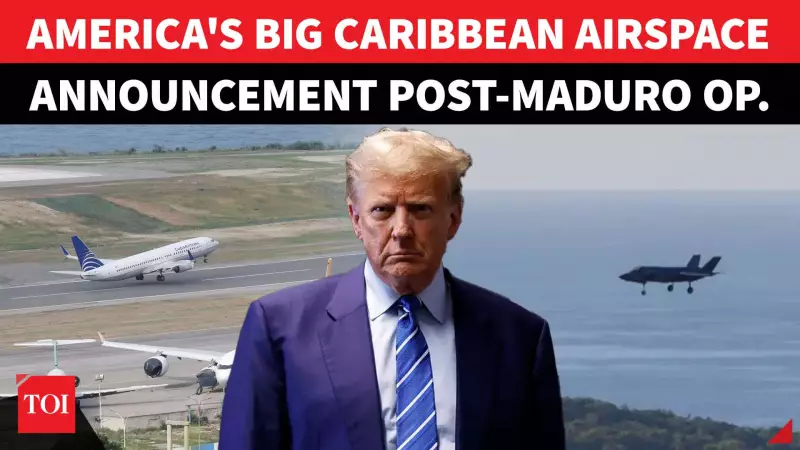
In a significant development following a major military intervention, the United States has officially lifted the emergency airspace restrictions it had imposed over the Caribbean region. This move comes after days of severe travel disruption that stranded thousands of passengers and forced the cancellation of hundreds of flights.
Airspace Reopens After Military Action
The Federal Aviation Administration (FAA) announced the decision to restore normal air traffic operations, effectively ending the safety warnings that were linked to the ongoing U.S. military activity in Venezuela. The restrictions were initially put in place as a precaution during the sensitive operation dubbed 'Op Absolute Resolve,' which resulted in the capture of Venezuelan President Nicolás Maduro.
The operation, which involved an estimated 150 American aircraft, culminated in Maduro's detention and subsequent transfer to the United States. President Donald Trump confirmed the successful capture, signaling a continued and deep U.S. involvement in the Venezuelan crisis. Videos circulating show Maduro being escorted by FBI agents and even giving a thumbs-up at a DEA office upon arrival in the U.S.

Travel Chaos and Recovery Efforts
The immediate consequence of the airspace closure was travel chaos across the Americas. Major airlines were forced to cancel hundreds of flights as they scrambled to comply with the sudden safety advisories. The ripple effect was felt globally, with passengers stuck at airports from Miami to Bogotá.
Now, with the restrictions lifted, carriers are in a race against time to restore their schedules. Airlines are deploying larger aircraft and adding extra seats on popular routes in a bid to clear the massive backlog of stranded travelers. However, industry analysts caution that a full recovery to normal operations could still take several days, given the scale of the disruption.
Broader Implications and Reactions
The military operation and its aftermath have triggered strong international reactions. China, which has significant financial interests in Venezuela, reportedly issued a stern warning to the U.S. Meanwhile, the political landscape in Venezuela has shifted dramatically, with Delcy Rodríguez now leading the country in the absence of a clear successor to Maduro.
Protests have erupted in cities like New York and Washington, reflecting a stark divide between Venezuelan expatriates celebrating Maduro's capture and critics condemning the U.S. action as an 'illegal war.' The United Nations is likely to address the situation, adding another layer to this complex geopolitical event.
The final moments of the operation, described by President Trump, involved a raid on a fortress, breached steel doors, and gunfire as Maduro attempted a failed bid to flee. This high-stakes mission has undoubtedly reshaped U.S.-Venezuela relations and will have lasting consequences for regional stability in Latin America and the Caribbean.