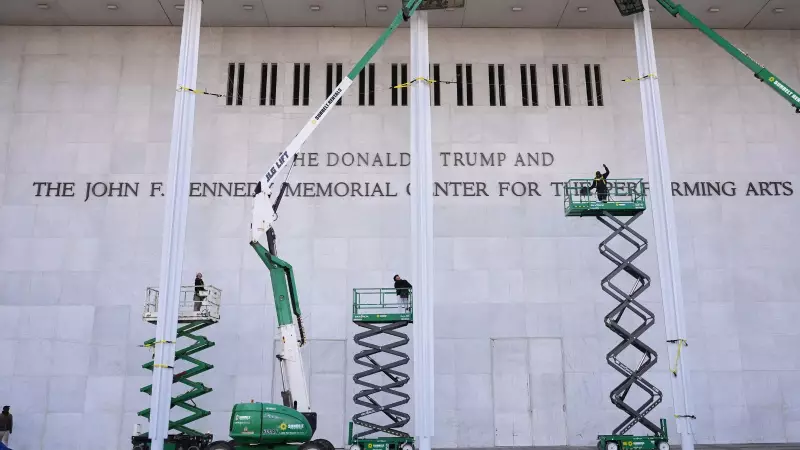
The United States Congress has taken a definitive stand to preserve the legacy of a former president, directly countering a move by supporters of another. In a significant legislative action, lawmakers have passed a law that explicitly blocks any attempt to rename the iconic John F. Kennedy Center for the Performing Arts in Washington D.C. after former President Donald Trump.
The Legislative Shield for a Presidential Legacy
This decisive move was embedded within a comprehensive $1.2 trillion government funding package, a critical piece of legislation signed into law by President Joe Biden on a recent Saturday. The provision acts as a legal firewall, stating clearly that none of the federal funds allocated can be used to "change the name of the John F. Kennedy Center for the Performing Arts." This action effectively thwarts any formal, funded effort to place Donald Trump's name on the national cultural landmark.
The push to rename the centre originated not from Trump himself, but from a faction of his staunch allies within the Republican party. Representative Guy Reschenthaler, a Republican from Pennsylvania, spearheaded this effort by introducing the "Donald J. Trump National Center for the Performing Arts Act" earlier in the year. The proposal argued that Trump's legacy deserved recognition on a scale matching the honour bestowed upon President John F. Kennedy.

A Clash of Legacies and Political Symbols
The Kennedy Centre, inaugurated in 1971, stands as a monumental tribute to the 35th President, John F. Kennedy, who was assassinated in 1963. It is more than a building; it is a symbol of his administration's emphasis on arts and culture. The attempt to rename it ignited a fierce debate about historical legacy, partisan politics, and the memorialization of presidents.
Democrats and many cultural observers were vehemently opposed to the idea. They viewed it as an inappropriate politicization of a non-partisan national institution. The congressional block represents a firm bipartisan consensus to keep the centre's identity intact, honouring the memory of JFK as originally intended. The legislative language leaves no room for ambiguity, creating a clear statutory barrier against a name change.
The funding bill, which included this specific provision, was passed to prevent a looming government shutdown. Its wide scope, covering several government departments, provided the perfect vehicle for lawmakers to settle this contentious cultural and political issue discreetly but firmly.
Implications and the Message from Capitol Hill
The outcome sends a powerful message from the legislative branch. It underscores that the naming of federally affiliated cultural institutions is subject to congressional oversight and approval, not merely the influence of political campaigns or individual supporters. By taking this step, Congress has asserted its role as the guardian of certain national symbols against short-term political pressures.
For now, the Kennedy Center retains its name, a testament to a president from the early 1960s. The episode highlights the ongoing cultural battles in American politics, where even the names on buildings become focal points for deeper ideological conflicts. The law ensures that, regardless of future political shifts, the centre's connection to President Kennedy remains legally protected, preserving a piece of American history as decided by its elected representatives.