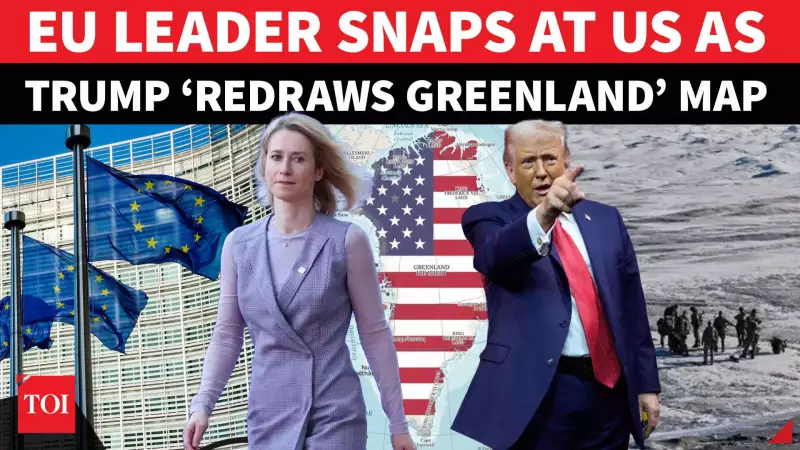
The European Union's top diplomat has issued a stark warning following provocative statements from United States officials regarding Greenland. EU foreign policy chief Kaja Kallas labelled the remarks as extremely concerning and confirmed that member states are actively deliberating their response.
Kallas Condemns Remarks in Cairo Address
Speaking from Cairo on January 9, 2026, Kallas directly addressed the situation. Her comments come in the wake of renewed focus from former US President Donald Trump on Greenland's strategic value, including reports of a symbolic $100,000 'offer' directed at Greenlanders. Kallas firmly stated that the principles of international law and the UN Charter must be upheld without exception.
She emphasised that respect for the territorial integrity of nations is a non-negotiable cornerstone of the global order. The EU chief argued that such public speculation from a major power does not merely concern a bilateral issue between the US and Denmark but has far-reaching repercussions.

A Threat to Global Order and Smaller Nations
Kallas articulated a clear warning: statements questioning established territorial boundaries actively undermine global stability. She highlighted that this creates a dangerous precedent, threatening the very protections that smaller countries rely on for their security and sovereignty.
The underlying tension revolves around the strategic Denmark-US alliance and its future trajectory. Greenland, an autonomous territory within the Kingdom of Denmark, holds significant geopolitical and military importance due to its location in the Arctic. The EU now finds itself in a delicate position, balancing its transatlantic ties with its fundamental commitment to a rules-based international system.
What Happens Next?
While Kallas confirmed that discussions are ongoing within the EU, the specific nature of potential responses remains unclear. The situation places Denmark, a loyal EU member, in a particularly sensitive spot. The bloc's reaction will be closely watched as a measure of its strategic autonomy and its willingness to defend diplomatic norms, even when it involves a key ally like the United States.
The episode underscores the ongoing shifts in global diplomacy, where traditional alliances are being tested by unilateral actions and rhetoric. The EU's firm stance, as voiced by Kallas, signals a readiness to confront challenges to the established international framework, regardless of their origin.