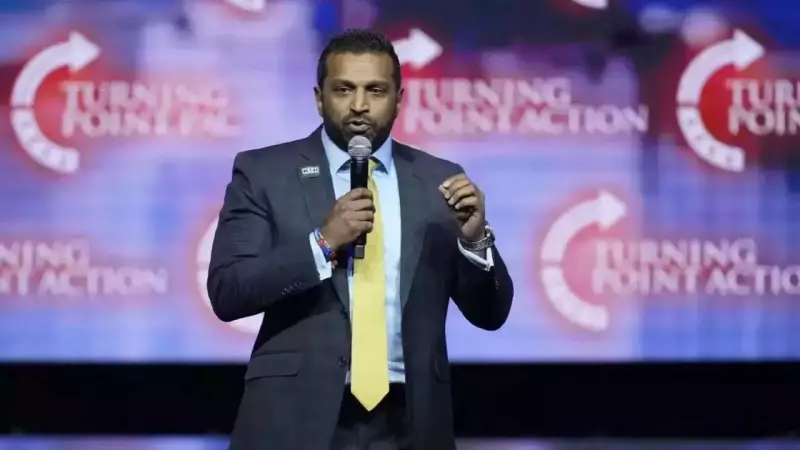
FBI Director's Firearm Comments Ignite Heated Debate Over Second Amendment Rights
The recent remarks made by FBI Director Kash Patel regarding firearms at protests have sparked significant controversy across the United States, raising fundamental questions about the interpretation and application of the Second Amendment. The discussion centers around the tragic case of Alex Pretti, who was reportedly carrying a firearm legally during a protest incident.
Patel's Controversial Statements on Protest Firearms
In his defense of ICE and Border Patrol operations, FBI Director Kash Patel made strong statements about firearm possession during protests. "No one who wants to be peaceful shows up at a protest with a firearm that is loaded with two full magazines," Patel asserted. "That is not a peaceful protest, and you do not get to touch law enforcement. You do that anywhere, this FBI is going to be following — leading the charge to arrest those."
Patel further clarified his position by stating, "You cannot bring a firearm, loaded, with multiple magazines to any sort of protest that you want. It's that simple. You don't have a right to break the law." These comments have drawn particular attention because Alex Pretti was reportedly carrying his firearm legally at the time of the incident.

The Second Amendment Context
The controversy directly engages with the Second Amendment of the United States Constitution, which states: "A well-regulated Militia, being necessary to the security of a free State, the right of the people to keep and bear arms, shall not be infringed." Patel's remarks have prompted widespread discussion about whether his position contradicts this constitutional protection.
Following the initial controversy, Patel attempted to clarify his stance by saying, "The FBI will always defend the First Amendment and the Second Amendment." However, this statement has done little to quell the growing debate among legal experts and citizens alike.
Netizens React Strongly to the Controversy
The online response to Patel's comments has been swift and passionate, with many social media users expressing deep concern about the implications for constitutional rights.
One prominent commentator noted, "I've been a gun owner my entire adult life. The leaders of a political party that claims to care about the Second Amendment say that because Alex Pretti was carrying a firearm at a protest, he deserved to be executed." This sentiment reflects a broader anxiety about how legal firearm possession might be interpreted in protest situations.
Another user articulated a fundamental concern about constitutional rights: "If legally possessing a weapon can be used to justify your execution, then the Second Amendment is meaningless. If speaking in opposition to the regime can be used to justify your execution as a 'terrorist,' then the First Amendment is meaningless."
A conservative voter from Minnesota expressed frustration with the situation, stating: "I live in Minnesota. I voted for Trump. I'm a conservative... he had a 2A Right to have a gun — They're shooting white people, Black people, everyone... wake the fuck up. Stop defending these motherfuckers. Martial law is right on our doorstep."
Another social media user criticized what they perceived as hypocrisy: "MAGA is actively posting against the Second Amendment today. 'Why did he bring a gun to a protest?' BECAUSE THE SECOND AMENDMENT SAYS HE CAN YOU F****** RETARDS."
The Broader Implications
This controversy highlights the ongoing tension between public safety concerns and constitutional protections in the United States. The debate touches on several critical issues:

- The interpretation of what constitutes "peaceful" protest when firearms are present
- The balance between law enforcement authority and individual rights
- The practical application of Second Amendment protections in modern protest scenarios
- The political dimensions of gun rights discussions in contemporary America
As the discussion continues to evolve, legal experts anticipate further examination of how existing laws and constitutional protections intersect with law enforcement practices during public demonstrations. The case has become a flashpoint in the larger national conversation about gun rights, protest rights, and the boundaries of law enforcement authority in the United States.