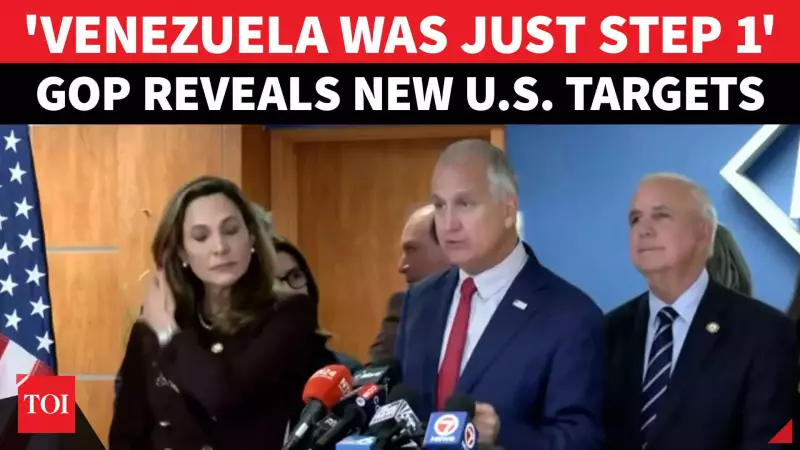
In a bold statement that has sent shockwaves through diplomatic circles, a prominent Republican lawmaker has strongly defended President Donald Trump's dramatic military action against Venezuelan leader Nicolás Maduro and hinted that more operations could follow. The remarks have intensified fears of a new, aggressive US policy towards governments it deems hostile in the Western Hemisphere.
Lawmaker's Stark Warning Following Maduro Capture
Republican Congressman Mario Díaz-Balart, a politician of Cuban origin, spoke forcefully in support of the operation that led to Maduro's capture. He praised the move as a decisive blow against dictatorship in the Americas. More alarmingly, he indicated that Caracas might not be the final target.
Díaz-Balart suggested that two more authoritarian regimes in the region could soon face similar action from the United States. While he did not explicitly name the nations, his comments have prompted immediate speculation and concern across Latin American capitals. The operation itself, which occurred recently, involved Maduro being apprehended and subsequently transported to the United States, where he was seen handcuffed and escorted by FBI agents.

A New 'Red Line' for US Foreign Policy?
The lawmaker's revelations point to a significant and potentially controversial shift in Washington's approach. It appears the US is now drawing a hard red line against governments it views as criminal, illegitimate, or hostile to its interests. The explicit mention of further regime change actions being "on the table" marks a stark departure from more traditional diplomatic postures.
This new stance was underscored by the details of the Venezuela mission, referred to as 'Operation Absolute Resolve'. Reports describe a complex operation involving approximately 150 American aircraft, leading to Maduro's capture within a tense 30-minute window. The Venezuelan leader is now reportedly jailed in New York.
Regional Repercussions and Global Reactions
The implications of this policy shift are vast. Díaz-Balart's warnings are raising alarms throughout Latin America, where many nations are wary of US interventionism. The move has also triggered global reactions, including a sharp response from China, which has significant financial stakes in Venezuela. Furthermore, the event has influenced other geopolitical dynamics, with figures like Ukrainian President Volodymyr Zelensky reportedly drawing parallels to Russia's actions.
Back in the US, the operation has sparked intense domestic debate. While some celebrated it as a victory for democracy, others have condemned it as an illegal act of war. Protests both supporting and opposing the action have erupted in cities like New York and Washington, highlighting the deep divisions the event has caused.
The coming weeks will be critical in understanding the full scope of this new US strategy. Whether Díaz-Balart's hints materialize into action against other nations remains to be seen, but the message to authoritarian regimes in America's backyard has been delivered with unmistakable clarity.