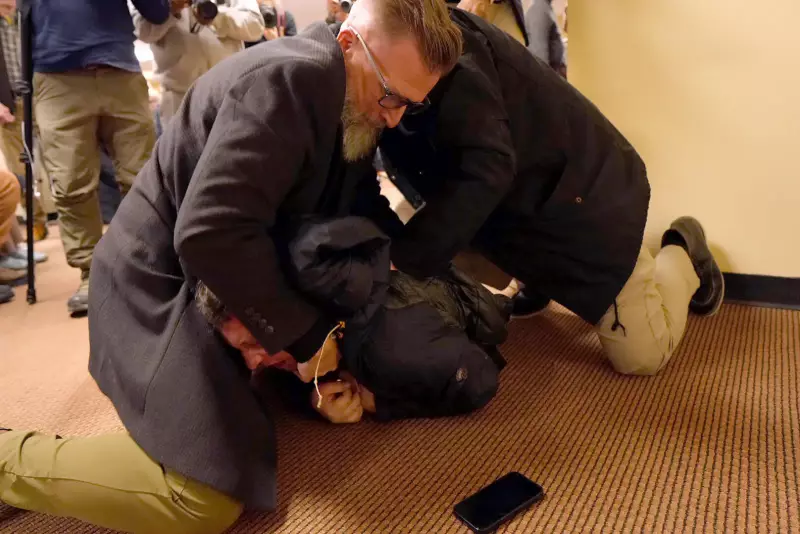
During a town hall meeting in Minneapolis this week, US Congresswoman Ilhan Omar faced a disturbing escalation beyond typical political heckling. As she began speaking, a man from the audience disrupted the event by spraying her with an unidentified liquid using a syringe, prompting immediate security intervention, an arrest, and heightened alarm over the increasing incidents of political violence across the United States.
What Exactly Happened at the Minneapolis Community Centre?
The incident unfolded at a community centre in north Minneapolis, marking Omar's first in-person town hall of the year. A man, later identified as Anthony James Kazmierczak, 55, stood up from the crowd, shouted at the congresswoman, and discharged a liquid from a syringe directly at her. Eyewitnesses reported that the substance emitted a strong, acidic odour, adding to the urgency of the situation.
Security Response and Arrest Details
Within moments, a security guard tackled the assailant, who was swiftly escorted out of the venue. Omar briefly moved towards the attacker but was advised by event organisers to conclude the gathering and seek medical attention. Demonstrating resilience, she declined and opted to continue with the town hall, emphasising her commitment to her constituents.

Kazmierczak was arrested and booked into Hennepin County jail on charges of third-degree assault. Police authorities confirmed that forensic teams were summoned to analyse and identify the mysterious liquid used in the attack.
Was Ilhan Omar Injured in the Assault?
Fortunately, no injuries were reported from the incident. Omar later reassured the public that she remained unharmed and vowed not to let such intimidation tactics hinder her legislative work or engagement with voters. In post-event remarks to reporters, she characterised the attack as an act of intimidation rather than a credible threat that would compel her to withdraw from public life.
Why This Incident Matters in the Current Political Climate
This attack occurs against a backdrop of growing unease regarding the safety of elected officials in the US, where threats, harassment, and physical confrontations have become more frequent amidst a deeply polarised political environment. The timing is particularly significant, as the town hall took place just days after public outrage in Minneapolis over fatal shootings involving federal law enforcement, and during a period of intensified rhetoric surrounding immigration policies.
Omar had utilised the same event to advocate for the abolition of Immigration and Customs Enforcement (ICE) and call for the resignation of Homeland Security Secretary Kristi Noem. This incident underscores how political gatherings, especially those addressing contentious issues like immigration and federal authority, are increasingly becoming flashpoints for violent confrontations.
Reactions from Across the Political Spectrum
Condemnation of the attack poured in from both sides of the aisle. Minneapolis Mayor Jacob Frey denounced the incident as unacceptable, stressing that political disagreements should never endanger lives. Democratic lawmakers connected the event to a broader atmosphere of escalating hostility towards public officials. Even Republican Congresswoman Nancy Mace, while critical of Omar's political stance, asserted that no elected representative should face physical assaults.
The Bigger Picture: Ilhan Omar's Polarising Role in US Politics
Ilhan Omar has long been a divisive figure in American politics, frequently targeted by right-wing critics. Her background as a refugee from Somalia who later became a US citizen has often been weaponised in political discourse. Omar has previously noted that threats against her tend to surge during periods of heightened political animosity, particularly when inflammatory language from national leaders normalises aggression towards political opponents.
This latest episode not only highlights the personal risks faced by public figures but also raises critical questions about the state of political discourse and safety in an era marked by deepening divisions.