Indian Migrants Continue US Border Crossings Despite Aggressive Enforcement
In a revealing statistic from 2025, United States Customs and Border Protection apprehended one Indian national approximately every twenty minutes throughout the year. This persistent flow underscores how the allure of the American dream continues to motivate thousands to undertake perilous and illegal journeys, even in the face of a stringent crackdown under the Trump administration.
Significant Drop in Numbers Yet India Remains a Top Source
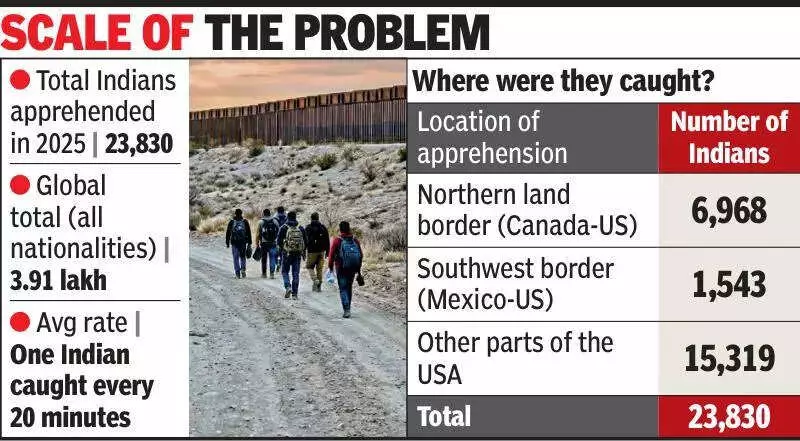
The official data shows that border officials intercepted 23,830 Indian citizens between January and December 2025. This figure represents a substantial decrease from the staggering 85,119 apprehensions recorded in 2024. Despite this notable decline, the numbers were sufficient to maintain India's position among the leading source countries for illegal border crossings into the United States.
Most of those detained were identified as single adults primarily motivated by the pursuit of employment and higher wages. However, enforcement agencies have raised concerns about an emerging and more troubling pattern: a small but consistent stream of unaccompanied minors being discovered near border areas.

Enduring Tragedy and the Paradox of Deterrence
Nearly four years after the heartbreaking Dingucha tragedy in January 2022—where four members of a family from Gandhinagar, Gujarat, froze to death while attempting to cross from Canada into the United States—children continue to be found abandoned in hazardous border zones. The 2025 statistics highlight a central paradox: while enhanced enforcement measures have successfully reduced the overall volume of illegal crossings, they have not diminished the underlying desperation and determination to attempt the journey.
For thousands of individuals, the perceived promise of economic opportunity and a better life in America continues to outweigh the formidable obstacles of border walls, increased patrols, and the inherent dangers of the journey.
US Officials Cite Policy Shifts and Enhanced Surveillance
American border authorities attribute the significant year-over-year reduction to a combination of factors:
- Stepped-up surveillance and monitoring technologies along key routes.
- Policy shifts and executive actions implemented under President Donald Trump.
- A sweeping, aggressive enforcement drive led by Immigration and Customs Enforcement (ICE).
These measures have effectively narrowed traditional smuggling corridors, intensified patrols, and sharpened penalties for those caught. Yet, as officials note, attempts have not ceased entirely.
"The data shows deterrence, not elimination," observed migration experts analyzing the flows. They point to the enduring economic and social magnetism of the United States, coupled with the adaptability of smuggling networks that quickly reconfigure and establish new routes when pressure mounts on existing ones.
Indian Agencies Echo Assessment, Highlight Regional Dynamics
Indian agencies, particularly those monitoring illegal immigration from states like Gujarat, corroborate this analysis. A senior officer involved in tracking these trends stated, "There is a massive decrease due to stricter US policies and a massive crackdown by agencies including ICE. But the numbers are still there because the aspiration of settling in the US, especially among Gujaratis, continues."
Evolving and Riskier Migration Pathways
While Mexico has historically served as a primary pathway, 2025 data indicated a visible geographical shift. A greater proportion of Indian nationals were intercepted along the Canada-US border, reflecting how smuggling operations are abandoning heavily policed Latin American corridors in favor of riskier northern alternatives.
The officer further explained, "Routes via Mexico and Canada through hubs like Dubai and Istanbul were the main illegal channels. These routes are now heavily hampered. People who want to illegally enter the US are still trying through newer, riskier paths." This adaptation demonstrates the resilience of both migrant aspirations and the smuggling networks that profit from them.

The situation remains a complex interplay of enforcement, economics, and human ambition, with no simple resolution in sight as long as the powerful pull of opportunity persists.