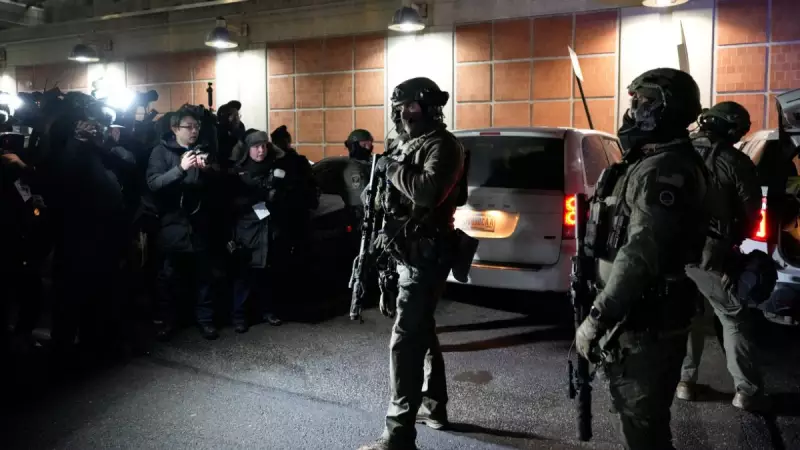
In a stunning development that has sent shockwaves through international diplomacy, the United States has successfully captured Venezuela's President Nicolas Maduro. This dramatic operation, culminating in his arrest, was the result of an intricate and clandestine plan spanning several months, according to exclusive details obtained by India TV.
The Elaborate Sting Operation
The core of the covert mission involved the construction of a full-scale mock house designed to replicate a safe house Maduro was expected to use. American intelligence and special forces operatives used this replica for extensive training and simulation exercises. The goal was to prepare for every possible scenario during the actual apprehension, ensuring the operation's success with minimal risk.
Authorities have confirmed that the planning phase was exceptionally detailed, accounting for Maduro's security detail, potential escape routes, and the political fallout. The decision to move forward was based on actionable intelligence regarding the Venezuelan leader's movements and a narrow window of opportunity. This was not a spontaneous action but a carefully choreographed military and intelligence feat.

Charges and International Backdrop
Nicolas Maduro faces a slate of serious charges in the United States. These include narco-terrorism conspiracy, corruption, and drug trafficking. The US Department of Justice has long accused Maduro and his inner circle of turning Venezuela into a hub for international drug smuggling, allegations Caracas has consistently denied.
The capture occurs against a backdrop of severe political and economic crisis in Venezuela. For years, the nation has been gripped by hyperinflation, widespread shortages, and a mass exodus of its citizens. The United States, along with dozens of other countries, recognizes opposition figure Juan Guaido as the legitimate interim president of Venezuela, having rejected Maduro's 2018 re-election as fraudulent.
Immediate Aftermath and Global Reactions
The immediate consequence of Maduro's capture has been a power vacuum at the highest level of the Venezuelan government. While the constitution outlines a succession plan, the political reality is fragmented between the Maduro-loyalist institutions and the US-backed opposition. The situation on the ground remains volatile, with fears of civil unrest or a forceful crackdown by remaining regime loyalists.
Internationally, reactions are sharply divided. Allies of the United States, including several Latin American nations and European partners, have cautiously welcomed the development as a potential step toward restoring democracy. Conversely, nations like Russia, China, Cuba, and Iran have condemned the action as a blatant violation of international law and an act of "gangsterism." They view it as an unlawful extraterritorial abduction of a sitting head of state.
The operation fundamentally alters the geopolitical landscape in the Western Hemisphere. It sets a precedent for direct action against leaders accused of criminal activities by Washington. Analysts are now watching closely to see if this emboldens further actions or leads to a protracted period of instability within Venezuela and diplomatic confrontation globally.
All eyes are now on the judicial process in the United States and the political maneuvering in Caracas. The coming days will be critical in determining whether this high-stakes operation leads to a peaceful transition or deepens the nation's tragic crisis.