

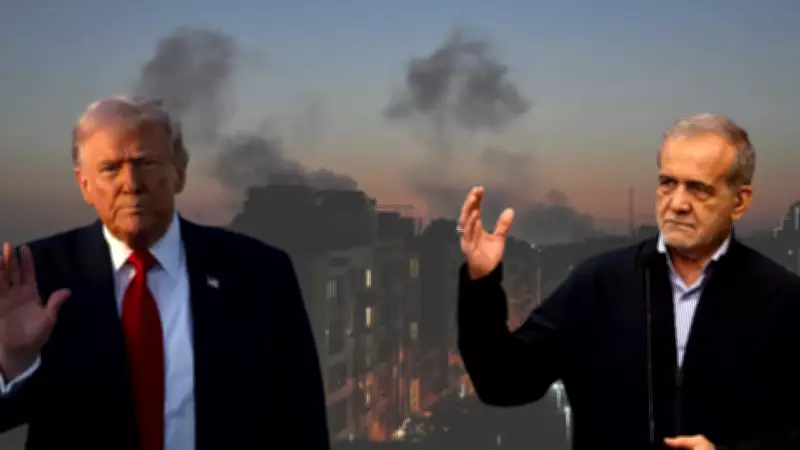
Iranian President Signals Conditional Readiness for Diplomatic Engagement
As hostilities between Iran and the United States continue to intensify across the Middle East, Iranian President Masoud Pezeshkian has indicated that Tehran may be willing to return to the negotiating table, but only under a strict set of conditions. This development emerges amidst a rapidly expanding regional conflict that now involves Israel and various allied groups, raising significant fears of prolonged warfare with severe economic and humanitarian repercussions.
Three Key Demands for Renewed Dialogue
According to statements from Iranian officials, Tehran would consider reopening diplomatic channels with Washington only if three critical demands are met. First, the United States must formally recognize Iran's sovereign rights. Second, reparations must be provided for the extensive damage inflicted during the ongoing conflict. Third, firm and enforceable guarantees must be established to prevent future military aggression against Iran. President Pezeshkian has engaged in discussions with leaders from Russia and Pakistan over the past two days, a move interpreted as signaling that diplomatic avenues could be reactivated despite the current state of war.
Iranian leaders have repeatedly expressed that they are awaiting a response from the opposing side but maintain deep skepticism regarding Washington's intentions. Officials in Tehran argue that years of confrontation, compounded by the current war, have severely eroded trust in any potential negotiations with the United States.

Regional Violence Escalates with Widespread Attacks
The comments from Iranian leadership come as the conflict between Iran, Israel, and their respective allies continues to expand, with violence now spreading across the Gulf region and the eastern Mediterranean. In a concerning development for global trade, a container ship near the United Arab Emirates was struck by a projectile, igniting a small fire, though the crew was reported safe. More critically, in the vital Strait of Hormuz, three crew members remain trapped aboard a Thai bulk carrier that was hit while transiting this crucial waterway, highlighting the growing and immediate risks to international shipping routes.
Regional tensions have escalated further following reports from authorities in Bahrain of attacks on fuel tanks in the Muharraq Governorate. Emergency crews battled resulting fires, and residents were urgently advised to remain indoors. Simultaneously, Saudi Arabia announced that its air defence systems successfully intercepted multiple drones targeting strategic areas, including one specifically headed towards the Shaybah oil field. Kuwait also reported intercepting several drones, indicating a coordinated pattern of aerial threats.
Israeli and Iranian Military Actions Intensify
Israel reported that a fresh wave of Iranian missiles was launched toward its territory, prompting the immediate deployment of air defence systems. In a robust response, Israeli forces carried out what they described as "wide-scale" strikes, targeting locations in Tehran and Hezbollah positions in Beirut. Lebanese authorities confirmed multiple casualties from these Israeli strikes, noting that some attacks impacted areas where displaced families had been seeking shelter, exacerbating the humanitarian crisis.
Global Energy Markets and Economic Stability at Risk
The intensifying conflict has already begun to disrupt global energy markets. Attacks on shipping near the Strait of Hormuz, one of the world's most critical oil transit chokepoints, have driven the price of Brent crude oil above $100 a barrel. This surge raises profound concerns that the war could trigger wider economic instability, affecting fuel prices and supply chains worldwide.

US Political Commentary and Iranian Warnings
Amidst these developments, former US President Donald Trump asserted that American strikes had already severely weakened Iran, telling supporters that the country was "pretty much at the end of the line." Concurrently, Iran issued a stark warning to several major US technology firms, including Google, Amazon, Microsoft, and Nvidia, labeling them as "legitimate targets" in the ongoing confrontation, further illustrating the multifaceted nature of the conflict.
The Indian Ministry of External Affairs has also condemned an attack on an India-bound Thai ship, remarking that the loss of innocent lives in the conflict is "unacceptable." As diplomatic manoeuvres, military strikes, and economic pressures continue to unfold, the situation in the Middle East remains highly volatile, with the potential for significant escalation hanging in the balance.





