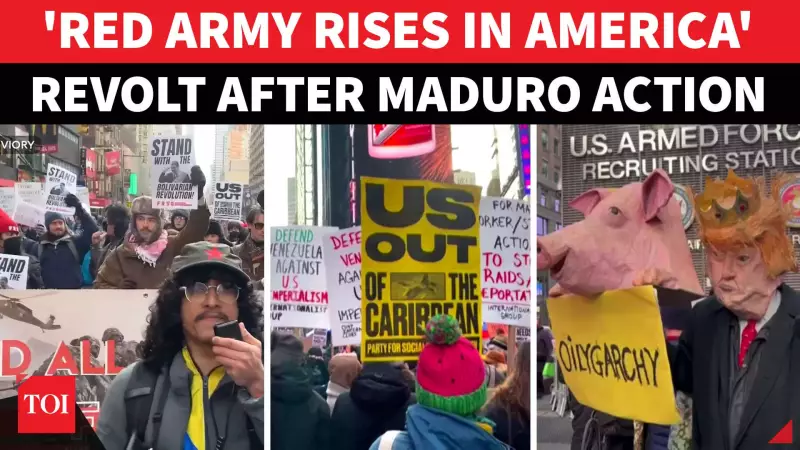
The dramatic capture of Venezuelan President Nicolás Maduro by U.S. special forces on January 5, 2026, has ignited not just a geopolitical firestorm but also triggered a massive, coordinated wave of protests across American cities. Within minutes of the news breaking, a well-organised Marxist-socialist network launched what Fox News described as a rapid propaganda blitz, mobilising thousands under the banner 'RED ARMY RISES'.
The Instant Mobilisation: A Military-Precision Psyop
This was not a case of spontaneous public outrage. According to reports, the response displayed military-like precision. A flood of coordinated posters and urgent calls-to-action swamped social media platforms almost instantly after the raid was confirmed. This digital onslaught was the catalyst for mobilising hardened activist networks across the United States.
The network declared an 'EMERGENCY DAY OF ACTION', leading to organised protests in major hubs like New York City and Washington D.C., as well as in over 100 other urban centres. The speed and scale of the mobilisation suggest a deep-rooted and pre-prepared operational capacity, aimed at capitalising on the incident to rally support against the U.S. government's actions.

The Raid and Its Immediate Aftermath
The triggering event was a high-stakes raid by U.S. forces, codenamed 'Operation Absolute Resolve', which successfully apprehended Maduro. The operation involved an estimated 150 American aircraft and culminated in a tense confrontation. President Donald Trump later admitted to taking a 'pretty bad' hit, referencing an unseen video that allegedly shows a Venezuelan missile striking a U.S. helicopter during the mission.
Maduro was swiftly transported to the United States, with footage showing an FBI escort leading the handcuffed leader who gave a thumbs-up at a DEA office. He is now reportedly jailed in New York. In Venezuela, power has shifted to Vice President Delcy Rodríguez, creating a leadership void that complicates U.S. strategic plans for the oil-rich nation.
Global Repercussions and Political Clashes
The capture has sent shockwaves through international diplomacy. China, with an estimated $100 billion in investments at stake in Venezuela, is reported to have issued an ultimatum to President Trump, demanding a stop to what it calls the 'toppling' of governments. Meanwhile, Ukrainian President Volodymyr Zelensky has allegedly urged Trump to similarly 'capture' Russian leader Vladimir Putin, seeing Maduro's abduction as a precedent.
Back in the U.S., the political and social fabric witnessed stark divisions. While the protests organised by the Marxist network painted a picture of domestic resistance, these clashes were mirrored by celebrations within parts of the Venezuelan diaspora, who called it the 'best day' of their lives.
The event underscores the complex interplay between modern military operations, instant digital mobilisation by ideological groups, and the fragile nature of international relations. The rise of the 'Red Army' protests on American soil marks a new chapter in how foreign policy actions can catalyse immediate and organised domestic unrest.