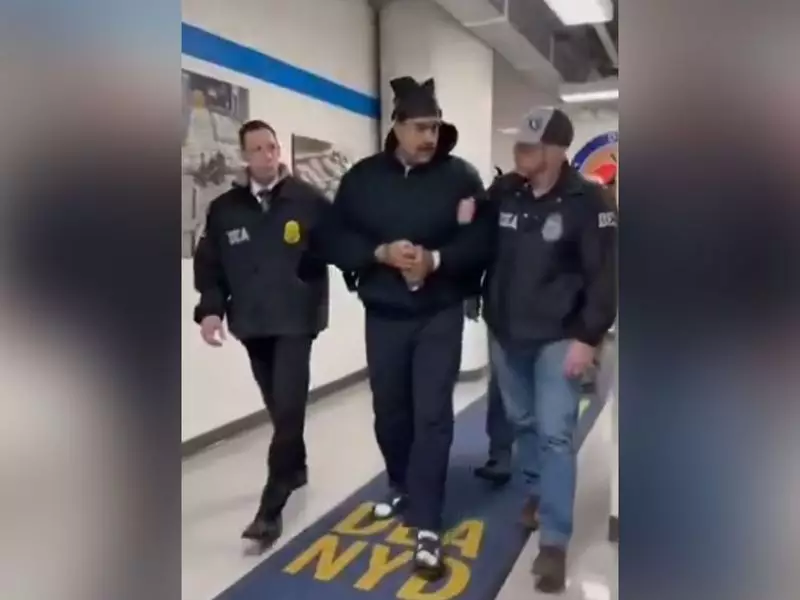
In a major escalation of legal and diplomatic tensions, Venezuelan President Nicolás Maduro and several high-ranking officials from his government are set to appear before a United States federal court. They face serious charges of narco-terrorism, conspiracy, and corruption, as detailed in a sweeping indictment unsealed by the US Department of Justice.
The Core of the US Indictment
The US authorities have leveled grave accusations against the Venezuelan leadership. The central allegation is that President Maduro, along with other powerful figures, conspired with the Revolutionary Armed Forces of Colombia (FARC) to flood the United States with cocaine. The indictment portrays this not as mere drug trafficking but as a coordinated narco-terrorism conspiracy aimed at destabilizing the US.
Among the key individuals named alongside Maduro is Diosdado Cabello, the head of Venezuela's pro-government Constituent Assembly and a man considered one of the most powerful political figures in the country. The charges suggest a state-sponsored scheme where the Venezuelan government provided safe passage for FARC-produced cocaine, using the country's ports and airspace. In return, the FARC and other groups allegedly provided financial and weapons support to the Venezuelan regime, helping it maintain power.

Details of the Alleged Criminal Enterprise
The indictment paints a detailed picture of the alleged criminal network. It claims that for over two decades, the Venezuelan leadership turned the nation into a global hub for drug trafficking and money laundering. The charges include:
- Conspiring to import cocaine into the United States.
- Engaging in narco-terrorism by using drug trafficking as a weapon against America.
- Corruption and bribery, with officials allegedly receiving millions in payoffs.
- Weapons trafficking to support terrorist organizations.
The US Justice Department asserts that the group, dubbed "The Cartel of the Suns," used its control over the military, police, and judiciary to facilitate the movement of multi-ton shipments of drugs. The timing of the indictment's unsealing is also significant, coming amidst heightened political strife in Venezuela and increasing US pressure on the Maduro administration.
Global Repercussions and Reactions
The legal action has sent shockwaves through international diplomatic circles. The Venezuelan government has vehemently denied all charges, dismissing them as a politically motivated fabrication by the Trump administration to justify regime change. They argue it is part of a long-standing campaign of economic and political aggression against Venezuela's sovereign government.
However, the US has offered a substantial reward of $15 million for information leading to Maduro's arrest and conviction, signaling the seriousness with which it is pursuing the case. This move effectively treats the sitting president of a nation as an international fugitive, a rare and extreme step in international relations. The case is being closely watched as it sets a precedent for using US courts to target foreign heads of state accused of crimes linked to terrorism and drug trafficking.
The implications extend beyond bilateral relations. It affects global counter-narcotics cooperation and could influence the stance of other nations regarding the legitimacy of Maduro's government. For the people of Venezuela, already suffering from a profound economic crisis, this development adds another layer of complexity to the nation's political future and its relationship with the rest of the world.
As the defendants are scheduled to make their virtual appearance in federal court, the world awaits the next chapter in this high-stakes legal drama that blurs the lines between international law, diplomacy, and criminal justice.