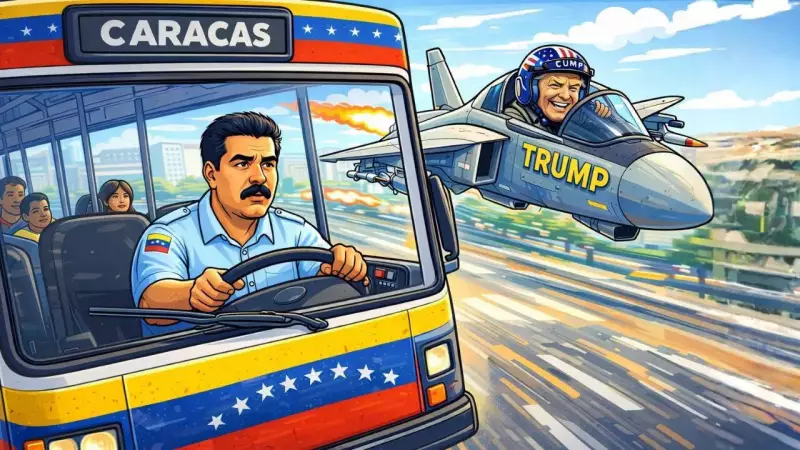
The story of Nicolás Maduro, who was forcibly removed from power in January 2026 after a controversial and enduring presidency, is a tale of two images. It begins with a bus driver in Caracas and ends with a leader being extracted by aircraft. This arc defines a political journey less about revolutionary triumph and more a stark lesson on how power can persist long after its legitimacy has faded.
From the Bus to the Presidential Palace: The Making of a Loyalist
Born in Caracas in 1962 into a working-class family, Nicolás Maduro's early world was one of trade unions and leftist organising, far from the halls of elite power. His time as a bus driver for the Caracas Metro taught him politics as a practical matter of discipline and hierarchy, not abstract theory. He was never known as a charismatic speaker or a profound socialist thinker. Instead, his skill was as an organiser, understanding how to hold a movement together under pressure.
This practical instinct perfectly aligned him with Hugo Chávez, the charismatic former army officer who transformed Venezuela after taking power in 1999. Chávez governed through spectacle and emotion, and he needed steadfast, low-profile operators around him. Maduro, unflashy and deferential, was ideal. He rose steadily, serving as a parliamentarian, speaker, and then as Foreign Minister for six years, embedding himself deep into the state's machinery while deftly avoiding the internal rivalries that consumed others.

The Custodian President: Power Without Popular Mandate
When Chávez's health deteriorated, the question of succession threatened to split his movement. In 2012, Chávez publicly anointed Maduro as his successor, a choice designed to preserve unity by selecting a non-threatening loyalist. Maduro's authority was rooted in proximity to Chávez, not in personal popularity. Upon taking office after Chávez's death, Maduro's mandate was clear: preservation, not transformation.
He won the presidency in 2013 by a narrow margin, and this fragility defined his entire rule. Governing became an exercise in endurance. State institutions—courts, electoral bodies, security forces—slowly morphed from referees into buffers for the regime. When opposition figure Juan Guaidó declared himself interim president in 2019, Venezuela was already in a state of suspended legitimacy. Maduro endured because political stalemates favour incumbents who can simply wait, and waiting became his primary governing method.
A Nation Hollowed Out: The Cost of Endurance
Venezuela's collapse under Maduro was not a sudden event but a slow, grinding process. The country's lifeblood, oil production, declined year after year due to gross mismanagement. Hyperinflation made currency nearly worthless, hollowing out salaries. Public services like hospitals and schools crumbled. Everyday life constricted into a struggle for basic survival.
This economic devastation triggered one of the largest migration crises in modern history. Millions of Venezuelans left their country, turning exodus from an exception into a defining national rhythm. Maduro often blamed an "economic war" and later international sanctions, but the structural decay was homegrown and preceded these external pressures. The state ceased to function for its people, even as the presidency continued operating as if mere continuity was an achievement.
The Mechanics of a Stalemate: How Maduro Actually Ruled
Maduro's surprising durability was built on a specific model of power. He did not rule through mass inspiration or outright terror, but through a web of adhesion and mutual dependence. The military was granted lucrative economic roles. Party elites were rewarded but kept divided to prevent challenges. Various security services were expanded. The goal was not dynamism but predictable stability, even if that stability was severely diminished.

Repression under Maduro became routine rather than spectacular. Opposition leaders were detained, disqualified from elections, or worn down by bureaucracy. Independent media outlets were gradually squeezed. Elections were held but were largely administrative rituals with predetermined outcomes. This predictable application of constraint fostered a national resignation, softening active resistance.
Sudden End to a Long Rule: Kidnapping and Aftermath
Maduro survived numerous elections, waves of protests, international sanctions, and even a parallel government because each challenge operated within the system he controlled. His removal in January 2026 succeeded precisely because it bypassed that system entirely through a dramatic kidnapping and extraction by plane. With Delcy Rodríguez stepping in, Venezuela entered another uncertain pause, not a renewal. The hollowed-out institutions and profound lack of public trust remain his most enduring legacy.
Nicolás Maduro will likely be remembered not as a revolutionary hero or a classic dictator, but as a case study in political endurance. His story shows how loyalty can substitute for competence, how habit can replace belief, and how the machinery of authority can keep functioning long after its purpose has evaporated. His fall was abrupt, but his rule was a slow, costly drain on a nation. The true arc of Maduro—from the bus to the aircraft—leaves behind a country still reckoning with the lost years and the empty endurance of power.