

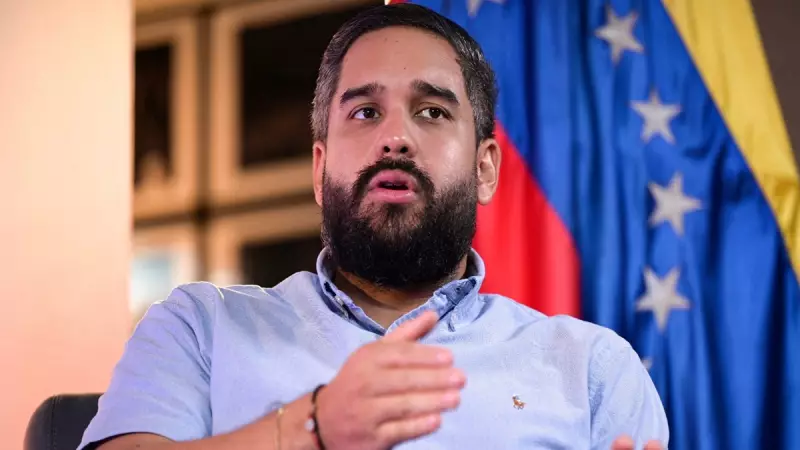
The political temperature between the United States and Venezuela has soared to a new high following explosive revelations of an alleged American plot to capture the South American nation's president, Nicolas Maduro. The controversy has now drawn a fiery response from a key figure within Maduro's inner circle: his son, Nicolás Maduro Guerra.
Son of Venezuela's Leader Issues Stark Warning
In a defiant statement made on Saturday, Nicolás Maduro Guerra, who is also a lawmaker in Venezuela's National Assembly, addressed the recently uncovered scheme. He declared that the historical record would ultimately identify and condemn those he labeled as "traitors" collaborating with foreign powers against Venezuela's sovereignty. His comments were broadcast on state television, channeling the government's official stance of resistance and condemnation.
The younger Maduro's remarks come directly in the wake of a detailed report by the Associated Press. The investigation, published on January 4, 2025, exposed a clandestine proposal presented to the US government. This plan, allegedly devised by a group of Venezuelan military exiles and American private contractors, outlined a multi-million dollar operation to apprehend President Maduro and transport him to the United States to face longstanding criminal charges.

Details of the Alleged US Capture Operation
The AP report meticulously laid out the blueprint of the audacious plan. A team of former Venezuelan military officials, operating from Colombia, reportedly approached US authorities with the proposition. The objective was clear: to seize the Venezuelan leader and deliver him to American soil. The US Department of Justice had previously indicted Nicolas Maduro and several top aides on charges including narco-terrorism and drug trafficking, offering a $15 million reward for information leading to his capture.
According to the investigation, the proposed operation carried a staggering price tag of approximately $200 million. The plan was formally presented to the US Drug Enforcement Administration (DEA) and other agencies. However, a senior US official, speaking on condition of anonymity, stated that the American government rejected the proposal. The official emphasized that the US does not approve of foreign military interventions aimed at regime change, distancing the Biden administration from the controversial scheme.
Venezuela's Government Reaction and Regional Implications
The Venezuelan government has seized upon this report as definitive proof of what it calls continuous "imperialist aggression" from Washington. Officials in Caracas have long accused the US of orchestrating coup attempts and destabilization campaigns, including a failed incursion in 2020 and numerous alleged assassination plots. This latest revelation provides potent fuel for their narrative of an ongoing foreign threat.
President Maduro himself has not yet publicly commented on this specific report, but his son's vehement statement serves as a powerful proxy. The incident is certain to further strain diplomatic relations, which have been frozen for years. It also casts a shadow over any potential future negotiations between the Maduro administration and the US-backed Venezuelan opposition. The episode underscores the deep-seated hostility and the complex, often shadowy, conflict that continues to define the relationship between the two nations.
As the international community digests this news, the focus remains on Caracas and Washington. The warning from Nicolás Maduro Guerra that "history will tell who the traitors were" is more than just rhetorical defiance; it is a declaration of the government's intent to identify and retaliate against perceived enemies, both domestic and foreign, ensuring this alleged plot becomes a central pillar in Venezuela's political discourse for the foreseeable future.






