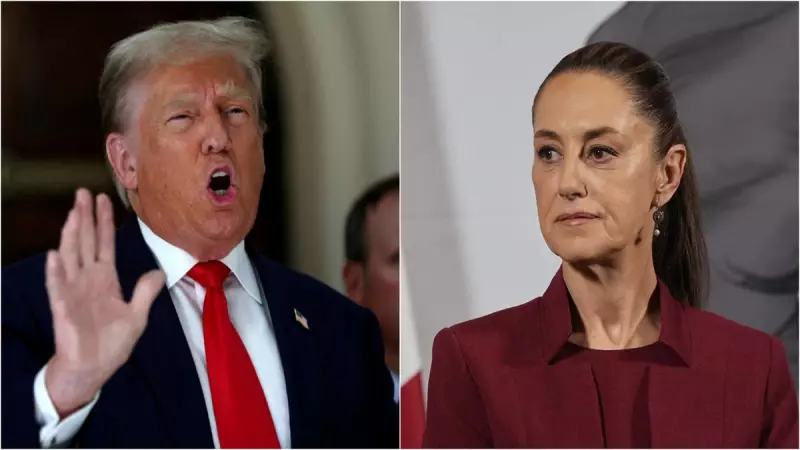
Mexican officials have moved to calm public anxieties regarding potential US military action, despite a fresh wave of threats from former US President Donald Trump that referenced the invasion of Venezuela. The response comes as regional tensions simmer following provocative statements from the Republican leader.
Mexico's Calm Response to Provocative Rhetoric
In the wake of Donald Trump's latest comments, which drew a parallel to military action in Venezuela, the Mexican government has adopted a notably measured tone. Authorities have publicly downplayed the immediate risk of any cross-border military intervention by the United States. This stance reflects a calculated diplomatic approach aimed at preventing escalation while acknowledging the complex history of US-Latin American relations.
The Mexican Foreign Ministry emphasized its commitment to resolving bilateral issues through dialogue and established legal frameworks. Officials pointed to existing treaties and mutual interests as buffers against drastic action, suggesting that alarm over Trump's rhetoric might be premature. However, analysts note that the government's calm exterior masks significant behind-the-scenes concern regarding the potential impact on trade, security cooperation, and regional stability.

Trump's Threats and the Venezuela Precedent
The core of the current diplomatic unease stems from statements made by Donald Trump, who has once again adopted a confrontational posture. In his remarks, he alluded to the possibility of a military incursion, explicitly referencing the US's historical and recent involvement in Venezuela as a potential blueprint.
This is not the first time Trump has used such language regarding Mexico, but the direct invocation of "Venezuela invasion" scenarios has raised the stakes. Security experts believe this rhetoric is designed to pressure Mexico on issues like immigration control and drug trafficking, but it inadvertently highlights the volatile nature of US foreign policy under a potential future Trump administration.
Regional Implications and Future Stability
The situation has repercussions far beyond the US-Mexico border. Other nations in Latin America are watching closely, wary of a return to an era of overt US interventionism. Mexico's public downplaying of the threat is seen as an attempt to project stability and avoid panic, both domestically and among its neighbors.
Economic and political analysts warn that sustained threats could undermine investor confidence in the region and strain diplomatic channels. While a full-scale military conflict is widely considered unlikely, the persistent verbal threats create an environment of uncertainty that can destabilize markets and diplomatic relations. Mexico's strategy appears to be one of cautious pragmatism, hoping to navigate the turbulent political climate without provoking further hostility.
Ultimately, the episode underscores the fragile state of inter-American relations. Mexico's muted response to Donald Trump's aggressive posturing, which included pointed references to Venezuela, serves as a testament to the delicate balancing act required in modern diplomacy amidst rising geopolitical tensions.