

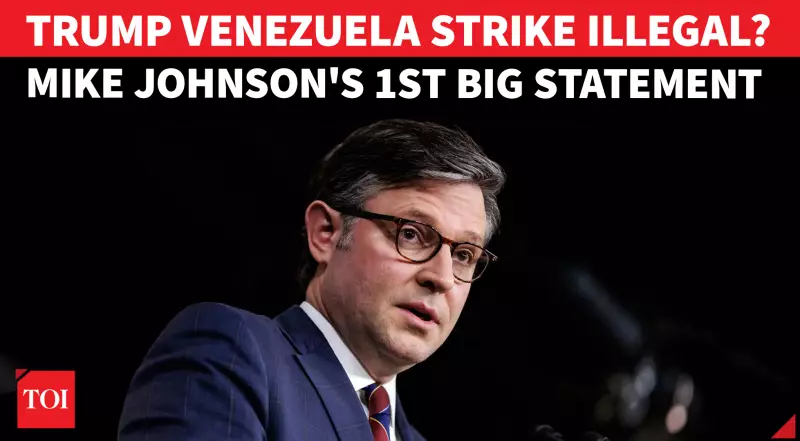
US House Speaker Mike Johnson has issued a robust defence of President Donald Trump's recent military action against Venezuela, pushing back against mounting criticism from lawmakers. Johnson asserted that the United States is not at war with Venezuela and that the Trump administration did not require congressional approval for the strikes.
Johnson Rejects Calls for Congressional Authorization
Speaking as tensions escalated on Capitol Hill, Johnson insisted that the War Powers Act does not apply to the recent US operations. He sharply rejected claims that President Trump had crossed any legal or military red line by ordering the attack. "Trump needed no approval from Congress," Johnson stated, framing the action as a targeted measure rather than an act of war.
He emphasised key points to justify the administration's position:

- The United States is not formally at war with Venezuela.
- There are no US troops stationed on Venezuelan soil.
- The US is not occupying the country in any form.
Growing Tensions and Political Clash
Johnson's remarks, made on January 6, 2026, come amid a fierce clash between lawmakers. Democratic critics and some legal experts have argued that the administration overstepped its constitutional authority by not seeking congressional authorization for the use of military force. The debate centres on the interpretation of the 1973 War Powers Resolution, which aims to check the president's power to commit US forces to hostilities.
The political fallout is significant, with reports indicating a split even within Trump's support base. Meanwhile, the situation in Venezuela remains volatile following the capture of President Nicolás Maduro, whose wife appeared bruised during his first court hearing. Maduro's son and allies have issued fiery responses, and global powers like China have warned the US against "acting like world cop."
Broader Implications and Next Steps
This defence from the top Republican in the House sets the stage for a protracted political and legal battle. The controversy touches on fundamental questions about executive power, congressional oversight, and the definition of war. As the Trump administration signals potential further action in the region and issues ultimatums to other nations like Iran, the precedent set here could have far-reaching consequences for US foreign policy.
The immediate focus remains on Capitol Hill, where lawmakers will continue to debate the legality and wisdom of the Venezuela operation. Johnson's firm stance suggests that the White House will face little pushback from the Republican leadership, ensuring the controversy will remain a deeply partisan issue.






