

NASA's Parker Solar Probe Makes Historic Discovery of Solar Storm Origins
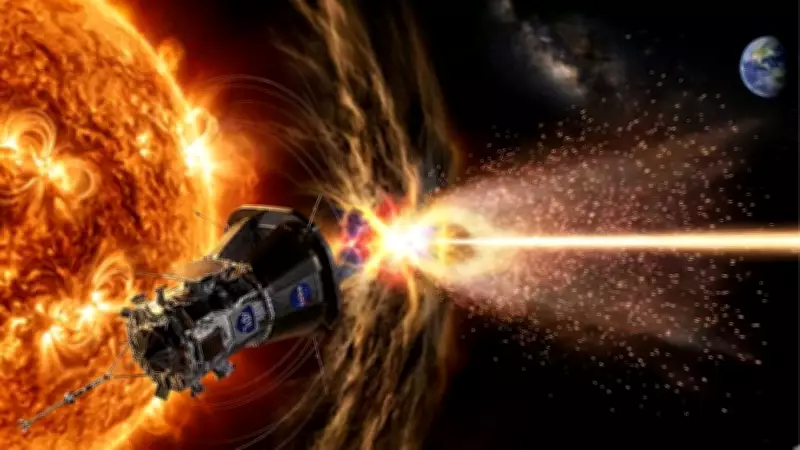
NASA's Parker Solar Probe has achieved a groundbreaking milestone in solar science by providing the first-ever direct in-situ measurements of magnetic reconnection, capturing the precise 'spark' that ignites powerful solar storms. During a high-speed flyby, the spacecraft traveled through and directly into a magnetic reconnection event—a phenomenon where opposing magnetic field lines violently snap and realign, explosively converting magnetic energy into kinetic particle velocity.
This process causes charged particles to accelerate away from the Sun at velocities approaching the speed of light, creating the solar storms that can impact Earth's technological infrastructure. The observations were made as the probe flew through the debris of these explosive events, giving scientists an unprecedented 'front-row seat' to the fundamental processes that drive space weather.
The Flashlight vs. Laser Particle Paradox
One of the most significant findings from the Parker Solar Probe's measurements reveals a surprising asymmetry in how different charged particles behave during magnetic reconnection events. Research published in The Astrophysical Journal Letters by Dr. Mihir Desai and colleagues demonstrates that protons and heavy ions accelerate in fundamentally different ways following these solar explosions.

Protons become energized and produce self-generated plasma waves that cause them to scatter broadly across a wide area, similar to how a flashlight beam spreads illumination. In contrast, heavy ions bypass this turbulence entirely, maintaining a collimated, high-energy trajectory that resembles a focused laser beam.
This discovery directly contradicts existing theoretical models that assumed all charged particles would accelerate uniformly during magnetic reconnection events. The 'flashlight versus laser' paradox represents a major advancement in our understanding of particle physics in solar environments.
Decoding Solar Storms Within the Heliospheric Current Sheet
Scientists have analyzed data from the Parker Solar Probe's 2022 flyby to confirm that solar storms originate from magnetic reconnection events occurring within the Heliospheric Current Sheet (HCS)—the 'magnetic equator' of our solar system. This critical sub-process happens when oppositely directed magnetic fields within the HCS converge and explosively release tremendous amounts of energy.
The spacecraft's sensors directly measured the transfer of energy from magnetic fields to the kinetic particles produced by these explosions. This data provides the first direct evidence linking specific magnetic reconnection events within the HCS to the generation of solar storms that travel toward Earth.
Why Understanding Solar Storms Is Critical for Earth
According to NASA scientists, decoding the origins of solar storms represents a vital priority for protecting Earth's technological infrastructure. The high-energy particles generated during these events can interfere with GPS systems, damage satellite electronics, and induce electrical currents that disrupt power grids serving cities and towns.
The scientific data gathered during these magnetic reconnection observations may enable a radically new approach to predicting space weather events. By enhancing models that detail how magnetic reconnection occurs, scientists can provide more accurate space weather forecasts, allowing for better protection of critical infrastructure that supports modern civilization.
This breakthrough represents a significant step toward developing early warning systems for solar storms that could potentially save billions in infrastructure damage and prevent widespread technological disruptions. As the Parker Solar Probe continues its mission, scientists anticipate further revelations about the fundamental processes that govern our Sun's behavior and its impact on our planet.

