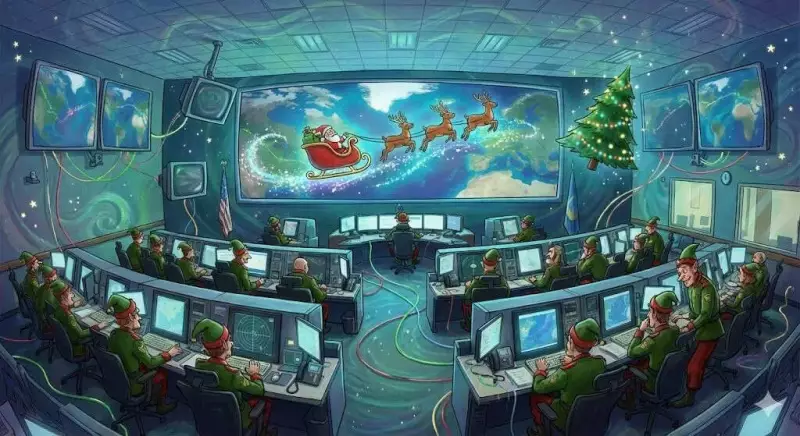
While families across the globe wrap gifts and prepare feasts on Christmas Eve, a unique operation springs to life deep within one of the world's most secure military installations. The North American Aerospace Defense Command (NORAD), tasked with guarding against nuclear threats and hostile aircraft, shifts its formidable surveillance apparatus to a singular, joyous mission: tracking the global journey of Santa Claus and his reindeer-led sleigh.
The Unlikely Origins of a Beloved Ritual
This heartwarming tradition, now in its seventh decade, began not with a strategic directive but a simple newspaper error. In 1955, a Sears department store advertisement inviting children to call Santa Claus accidentally printed the hotline number for the Continental Air Defense Command (CONAD), NORAD's predecessor. Instead of dismissing the calls, the alert officer on duty, Colonel Harry Shoup, decided to play along. He assured the children that his team had indeed spotted Santa on their radars, sparking immediate delight.
The public response was so overwhelmingly positive that the military command institutionalized the practice. When NORAD was formed in 1958 as a joint U.S.-Canada organization, it proudly adopted the Santa-tracking duty. What started as a charming mistake has evolved into a global phenomenon, offering a rare blend of institutional solemnity and childlike wonder.

The "Serious" Technology Behind the Christmas Magic
NORAD explains its Santa-tracking capabilities with a perfectly straight face, leveraging its actual defense technology to craft a believable narrative. According to their official lore, the journey begins with the North Warning System of powerful northern radars detecting Santa's departure from the North Pole.
Once airborne, infrared satellites pick up the distinct heat signature of Rudolph's famous glowing red nose—a clever parallel to the systems designed to detect the heat from missile launches. As Santa enters sovereign airspace over North America, NORAD fighter jets from both the United States and Canada are dispatched for a friendly visual escort, with pilots often reported to exchange cheerful waves.
The entire operation is run with the same professionalism as any other mission. Thousands of volunteers, many of them military personnel and their families, staff phone lines and computer systems on December 24th, handling millions of inquiries from children worldwide.
How the World Tracks Santa with NORAD
For the public, the magic unfolds through several channels. The cornerstone is the NORAD Tracks Santa website, which features a live, animated map following Santa's progress across continents and time zones. The site offers countdowns, games, and festive facts about cities on his route.
For a more personal touch, families can still call the dedicated NORAD Santa hotline to speak directly with a volunteer who provides real-time updates on Santa's location, speed, and even his cookie consumption at various stops. Updates also flow consistently through social media platforms like Facebook, X, and Instagram, and via a dedicated mobile app.
In an era where advanced surveillance often evokes concerns over privacy and control, NORAD's Christmas Eve mission presents a poignant counter-narrative. For one night, technology built for vigilance is repurposed for spreading joy. Radars seek out generosity instead of threats, and the only launches monitored are those of a sleigh full of gifts. This enduring tradition stands as a powerful reminder that even the most hardened institutions can—and should—make room for imagination, shared belief, and a touch of holiday wonder.