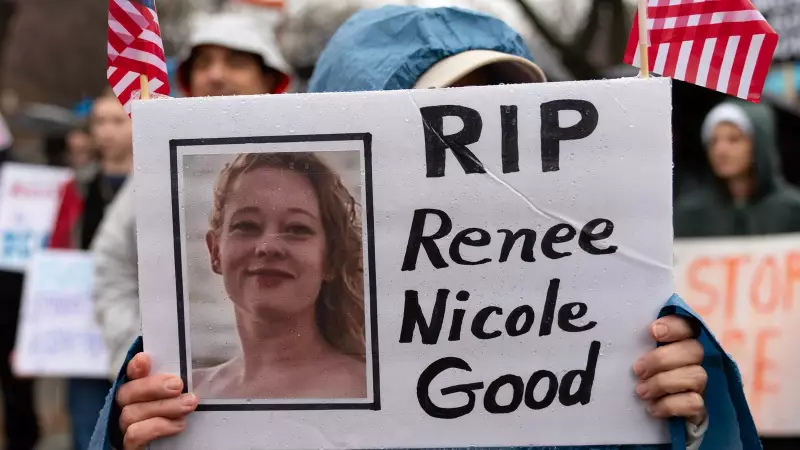
The chilling final moments of Renee Good, a poet and mother of three, have ignited a national firestorm in the United States, exposing what critics argue is the calculated cruelty at the heart of Donald Trump's second-term agenda. On a snowy Minneapolis street, Good was shot in the face by a heavily armed Immigration and Customs Enforcement (ICE) agent, an act captured on multiple videos, including the agent's own cellphone.
A Calm Smile, Then a Bullet: The Minneapolis Incident
The incident unfolded as ICE agents conducted deportation roundups. After dropping her six-year-old son at school, Renee Good found herself in their path. Witness footage confirms she posed no threat. Her last recorded words, spoken with a calm smile to a masked agent in full combat gear, were, "That's fine, dude. I'm not mad at you." Twenty-four seconds later, he fired. The last thing she likely heard was his parting insult: "F***ing bitch!"
This was not an isolated act by a rogue officer but a symptom of a militarized force. At Trump's request, Republicans last year funded ICE with resources surpassing most of the world's national armies. Agents now patrol American cities with automatic rifles, flak vests, helicopters, and Mine-Resistant Ambush Protected vehicles (MRAPs)—equipment designed for war zones like Kandahar. This immense power is being turned against undocumented residents, creating what many describe as an army of occupation.

Administration's Swift Justification and the "Cruelty is the Point" Doctrine
In a stark departure from standard protocol, President Trump declared the killing justified before any investigation commenced. His administration swiftly rallied behind the shooter. Homeland Security Secretary labelled the victim a "domestic terrorist," while Vice President J.D. Vance suggested the agent "deserves a debt of gratitude." The FBI, led by a Trump loyalist, seized the case, blocking access for local and state authorities.
This response aligns with a long-observed pattern. As writer Adam Serwer noted during Trump's first term, "The cruelty is the point." Analysts argue that brutality is not a byproduct but a central pillar of Trump's program. The objective is to use exemplary violence to terrify and subdue the population. From family separations at the border to cutting aid to the vulnerable, the administration consistently chooses the most savage option over the merely effective, feeding a sadistic hunger within its base and demoralizing opposition.
Why Renee Good's Death is a Watershed Moment
For years, Trump's most severe policies disproportionately targeted marginalized groups—undocumented immigrants, racial minorities, the poor—allowing many Americans to look away. Renee Good shattered that illusion. She was a middle-class, white, English-speaking U.S. citizen. Her death proved that no one is truly safe from the regime's gun sights.
This realization is fueling unprecedented dissent. Massive "No Kings" protests have swept the nation, occurring at over 2,000 sites across all 50 states just three months ago. Turnout has grown with each successive wave, from April to June to October. A critical question now looms: how many millions will protest next, and will it be enough to prompt Congressional action, such as impeachment?
Trump's public alignment with Good's killer serves as a grim warning to all potential dissenters. It raises the stakes of peaceful protest and acts of solidarity, like warning communities of ICE raids. The message is clear: the penalty for defiance can be fatal. The killing of Renee Good, whether she was an activist or simply in the wrong place, demonstrates that the administration's cruelty knows no bounds and is deliberately designed to force the entire nation into submission.