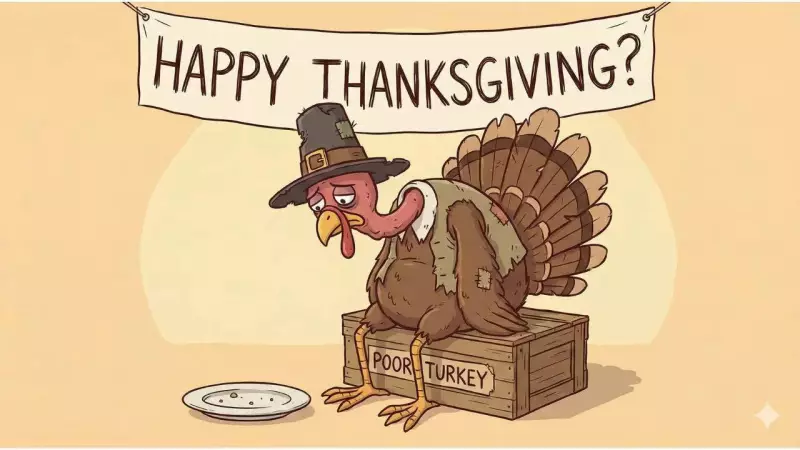
In a nation that once revolted over tea prices, Americans have developed an unusual fascination with the cost of their Thanksgiving turkey. Each November, economists, politicians, and supermarket executives engage in heated debates about poultry prices, treating the discussion with the gravity of national security. This year, however, the conversation has taken an unexpected turn with a word Americans haven't heard in years: down.
The Thanksgiving Illusion: Selective Price Drops
While official reports celebrate cheaper Thanksgiving dinners, the reality is more complex. The average cost of a classic Thanksgiving meal for ten has indeed decreased by a few percentage points, primarily driven by significantly cheaper turkey prices—the sharpest drop witnessed in years. This decline has single-handedly lowered the overall meal cost, creating an impression of widespread affordability.
However, the world surrounding that turkey tells a different story. Food-at-home prices remain substantially elevated compared to pre-pandemic levels. Everyday essentials including cereals, fresh vegetables, condiments, and beverages continue their upward climb. Grocery bills aren't collapsing; they're simply not rising as aggressively as during the peak inflation years of 2022 and 2023.

Retail Strategy: The Loss Leader Game
Why are turkeys becoming cheaper when everything else remains expensive? The answer lies in sophisticated retail psychology. Supermarket giants are deliberately selling turkeys at or below cost, treating them as strategic loss leaders designed to lure customers into stores.
Grocery chains understand that Thanksgiving shopping operates like a ritual—consumers must purchase the turkey, the sides, and all the extras. The only question is where they'll make these purchases. By offering dramatically discounted turkeys, retailers ensure customers choose their stores, banking on the probability that shoppers will buy all other items at regular prices.
This strategy comes despite rising wholesale costs for retailers themselves. Disease outbreaks in turkey flocks and persistently high feed costs have increased acquisition prices, but supermarkets are absorbing these losses because the turkey discount serves as an unbeatable customer acquisition tool.
The Farmer's Unseen Struggle
While consumers celebrate cheaper Thanksgiving meals, American farmers face a dramatically different reality. The agricultural community enters this holiday season with little to celebrate, as input costs remain stubbornly high while crop prices decline.
Fertilizer, fuel, machinery, and labor expenses continue to burden farmers, compounded by unpredictable weather patterns including droughts, heat waves, and erratic rainfall that disrupt yields. Turkey farmers specifically have suffered devastating blows from avian flu outbreaks, where single infections can lead to entire flocks being culled, representing financial catastrophe for operations that spent months raising hundreds of birds.
The Thanksgiving discount that consumers enjoy becomes possible only because someone else in the supply chain absorbs the pain. Retailers can compress margins temporarily, but farmers have no margins left to sacrifice.
The Political Poultry Index
Thanksgiving turkey prices have inevitably become political ammunition. Every White House administration, regardless of party affiliation, eagerly claims credit for "cheaper Thanksgiving" meals, even when the primary drivers are retail strategies rather than government policies.
Politicians this year repeatedly highlight how Thanksgiving meals have become significantly cheaper compared to last year. However, they carefully avoid comparisons with 2018 or 2015 prices, as those comparisons prove far less flattering to current economic narratives.
The turkey aisle transforms into a political stage where optics serve multiple interests—retailers gain customer attention, politicians secure talking points, and consumers receive the illusion of economic victory.

The Bundled Meal Revolution
Another significant trend emerging this Thanksgiving season involves pre-assembled meal kits from big-box retailers. These complete Thanksgiving packages promise to feed families for less than traditional do-it-yourself costs, representing what appears to be efficiency and savings.
Beneath the surface, however, lies a fundamental shift in holiday traditions. When consumers outsource their Thanksgiving meals to corporations, companies gain control over what dishes qualify as "standard," how many portions constitute "normal," which ingredients get included or excluded, and how much profit margin they can conceal within bundled pricing.
This corporate curation of holiday meals represents the Netflix-ification of Thanksgiving traditions, where companies decide the menu and consumers simply show up to participate.
The Economic Reality Behind the Discount
When we strip away the marketing narratives and examine the actual mechanics, several key factors explain this year's Thanksgiving price phenomenon:
Retailers are deliberately discounting turkeys as loss leaders to attract holiday shoppers. Wholesale costs haven't collapsed, meaning the discount represents financed illusion rather than genuine market shifts. Certain food categories—particularly grains—have experienced price cooling, reducing costs for specific items. Other categories including vegetables, fruits, and beverages remain expensive. Consumers increasingly trade down to store brands, frozen pies, and simplified menus. Farmers confront higher operational costs with shrinking margins. Overall inflation shows signs of slowing rather than reversing. Political narratives often overshadow macroeconomic realities.
This year's cheaper Thanksgiving doesn't prove economic recovery but demonstrates retailer expertise in narrative management. The Thanksgiving basket functions as a public relations campaign wrapped in aluminum foil, illustrating how the American consumer economy operates during inflationary periods.
When inflation rages, retailers raise prices. When inflation softens, retailers lower selective prices and market it as generosity. During economic uncertainty, the turkey becomes a bargaining chip in the psychological battle for customer loyalty.
The ultimate irony remains that Americans will gather around their tables this November, expressing gratitude for slightly cheaper meals. Yet these price cuts don't stem from benevolent markets, miraculous supply chain recoveries, or sudden government competence. They result from carefully calibrated retail economics where someone decided your gratitude was worth a discounted bird, farmers paid for that gratitude through their margins, and the rest of the store quietly recovered what the turkey lost.
The turkey might be cheaper, but the world surrounding it isn't. In a year where everything feels fragile, America will embrace the small victory—even when it's cooked, seasoned, and packaged to perfection by marketing departments.