The United States of America, today's undisputed global leader in economic, military, and technological spheres, was not born a giant. Its journey from a cluster of colonies to a continental and then a world power is a tale of aggressive ambition, strategic acquisitions, and an unwavering belief in its destiny. The nation's relentless pursuit of growth, echoed in the words of leaders like General George S. Patton, has defined its character for centuries.
The Continental Foundation: War, Purchase, and Doctrine
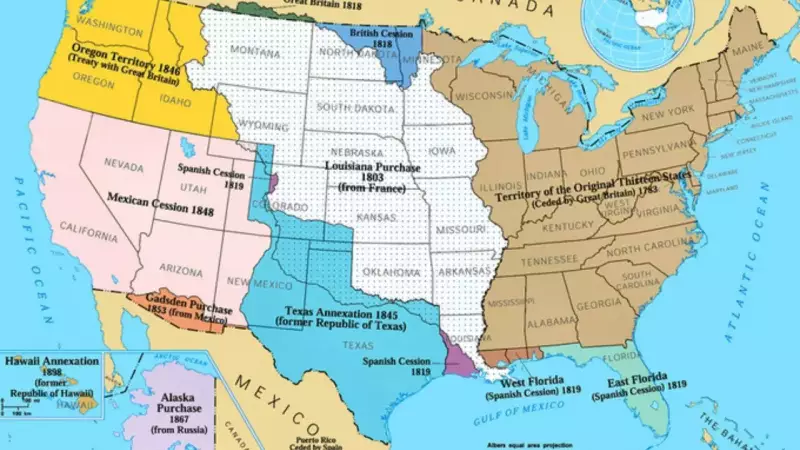
The story of American expansion begins with its birth. After 176 years of British colonization from 1607 to 1783, the American Revolutionary War (1775-1783) secured independence. The new republic instantly inherited British territorial claims east of the Mississippi River, transforming the original 13 colonies into a fledgling nation.
President Thomas Jefferson then pulled off a monumental deal in 1803: the Louisiana Purchase. For a mere $15 million, the US bought approximately 827,000 square miles of land from France's Napoleon Bonaparte, effectively doubling the country's size and securing the vital Mississippi River corridor.

This westward push was fueled by the ideology of "Manifest Destiny," the belief that American expansion was divinely ordained. This justified the forced displacement of Native American tribes. President Andrew Jackson's Indian Removal Act of 1830 legally enabled the relocation of indigenous peoples to lands west of the Mississippi.
Securing Borders Through Conflict and Diplomacy
America's southern flank was consolidated through a mix of pressure and war. Florida, then a Spanish territory, was ceded to the US in 1819 via the Transcontinental Treaty, following American military incursions.
The annexation of the Republic of Texas in 1845 triggered the Mexican-American War (1846-1848). America's victory was decisive, adding over 500,000 square miles of territory, including the future states of California, Nevada, Utah, Arizona, and New Mexico.
In the northwest, a long-standing dispute with Great Britain over the Oregon Territory was resolved peacefully. The Oregon Treaty of 1846 established the border at the 49th parallel, granting the US present-day Oregon, Washington, Idaho, and parts of Montana and Wyoming.
From Continent to Global Empire
America's ambitions soon looked beyond its shores. In 1867, Secretary of State William H. Seward negotiated the Alaska Purchase from Russia for $7.2 million. Initially mocked as "Seward's Folly," it proved a masterstroke, adding immense natural resources.
The turning point to global empire came in 1898 with the Spanish-American War. Victory gave the US Puerto Rico, Guam, and the Philippines. That same year, the US annexed the Kingdom of Hawaii through the Newlands Resolution, capitalizing on its strategic Pacific location after supporting the overthrow of its monarchy in 1893.
The underlying pattern is clear: the United States used every tool available—military force, economic power, diplomatic pressure, and ideological conviction—to expand its territory and influence. Its map was not drawn overnight but through a deliberate, often aggressive, century-long campaign. This relentless drive for more land, resources, and power laid the foundational stone for its current status as the world's preeminent superpower.