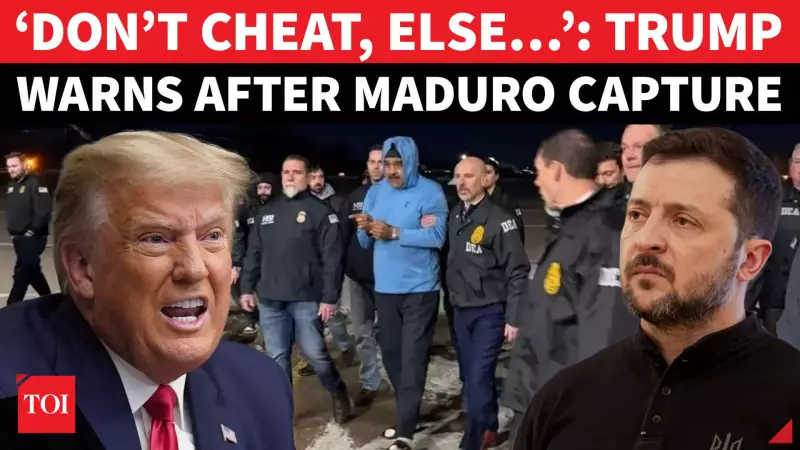
In a dramatic escalation of rhetoric, former US President Donald Trump delivered a blistering critique of Ukraine, branding the nation as fundamentally "corrupt." The comments were made during a charged address to Republican lawmakers in Washington DC on January 7, 2026.
A Fiery Accusation and a Stark Warning
Trump did not mince words in his assessment of Kyiv's leadership. He asserted that Ukraine had broken an anti-corruption agreement "many times" and positioned himself as the ultimate arbiter of accountability. "I warned them not to cheat," Trump declared, painting a picture of himself as the enforcer who had consistently held the Eastern European nation to account. His speech, laden with stark language, underscored a deep-seated skepticism towards Ukraine that has long been a hallmark of his political stance.
Global Context: The Shadow of Maduro's Capture
This verbal assault on Ukraine did not occur in a vacuum. It came against the backdrop of a major geopolitical event: the capture of Venezuelan President Nicolás Maduro by US forces. The timing is significant, suggesting a broader pattern of assertive, unilateral American action on the world stage under Trump's potential return to power. Maduro's subsequent court appearance, where his wife was seen with visible bruises, and the fiery response from his son, who denounced "traitors," have plunged Venezuela into further crisis.

Ripples of Reaction and Future Implications
The fallout from Trump's address and the Maduro operation is spreading rapidly. Reports indicate a sharp division within his own MAGA movement, while Democratic opponents are reportedly renewing calls for impeachment. Internationally, reactions are pouring in. Chinese leader Xi Jinping has issued another warning to Trump against "acting like world cop," allegedly exposing an underlying "oil game." Meanwhile, Iran's Supreme Leader Khamenei is rumoured to be preparing for potential relocation to Russia as Trump issues ultimatums over the IRGC's actions. The former president has also signalled the possibility of a second invasion in the Americas if Maduro's deputy, Delcy Rodríguez, disobeys US demands, starkly proclaiming that "the US is in charge."
Trump's combined approach—a harsh verbal attack on a European ally coupled with direct military action in South America—marks a volatile shift in international relations. It raises urgent questions about the future of US foreign policy, the stability of global alliances, and the potential for further conflicts as 2026 begins.