

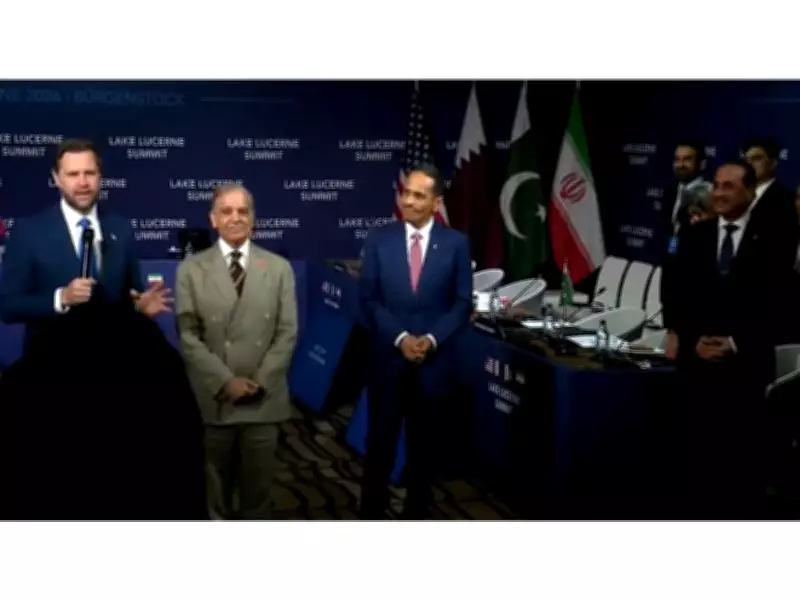
US Vice President JD Vance announced on Sunday that President Donald Trump is fully committed to establishing a comprehensive regional ceasefire in West Asia, actively using diplomatic channels to reset relations with Tehran. Speaking at a press conference during the ongoing Swiss diplomatic talks in Burgenstock, Vance provided an assessment of the evolving security situation, noting that critical stabilisation efforts are moving in the right direction despite operational frictions.
Commitment to Ceasefire and Progress in Lebanon
"Trump is committed to seeing a full regional ceasefire," Vance stated, while acknowledging the complex realities of maintaining active truces. He described these ceasefires as "a little bit messy" but pointed to tangible improvements on the western front. "We've seen great progress over the last couple of days in ensuring the ceasefire in Lebanon holds," Vance added, identifying stabilisation of the Lebanese border as crucial for broader regional compliance.
Turning Over a New Leaf with Iran
Vance revealed that the White House has authorised a paradigm shift toward Tehran. "Trump asked us to 'turn over a new leaf' to transform our relationship with the people of Iran," he explained, outlining a vision of mutual cooperation for long-term economic and security dividends. Expressing optimism about back-channel deliberations, he said, "Now we see a future together where everyone can work together to promote peace and prosperity." Highlighting the rapid pace of negotiations, Vance noted, "We have made great progress in the last few hours."

Addressing Regional Instability
Vance did not shy away from confronting geopolitical challenges, framing Iran's regional operations as a primary hurdle. "Iran has been a driver of regional instability," he remarked, reaffirming that the Trump administration views structured dialogue, not military escalation, as the primary vehicle for permanent stabilisation. "What we're trying to accomplish is, through diplomacy, to work together to transform the Middle East," he said.
Permanent Change in Relations
According to Vance, the overarching mandate goes beyond a temporary freeze in hostilities, aiming for a durable framework to reshape the geopolitical landscape. "The question is whether we can change relations in the Middle East permanently," he said, attributing the diplomatic opening to political backing from the White House. "Trump empowered us to find a diplomatic solution to a host of issues," Vance noted.
Historic Talks and Technical Negotiations
Vance described the face-to-face talks at the alpine resort as monumental and unprecedented. "The technical negotiations may not solve every disagreement, but they will allow us to sit together as teams for the first time in history," he said. The talks gained momentum following the arrival of heavyweight delegations at the Burgenstock resort on Sunday. These technical-level negotiations operate under a 14-point Memorandum of Understanding (MoU) finalised on June 17 by President Trump and Iranian President Masoud Pezeshkian, initiating a strict 60-day window for negotiators to resolve key operational disputes.
Delegations and Delays
To handle the framework's dense technical dimensions, Vance joined American negotiators Steve Witkoff and Jared Kushner at the venue. The high-level Iranian delegation, comprising parliamentary speaker Mohammad Bagher Ghalibaf and Foreign Minister Abbas Araghchi, along with officials from Iran's central bank and oil ministry, arrived to lay out Tehran's terms. The proceedings, originally scheduled for Friday, faced unexpected delays due to recent exchanges of fire between Israel and Lebanon.
Strategic Energy Corridors
Beyond territorial concerns, a primary objective is securing critical global energy corridors. The initial finalisation of the MoU prompted the reopening of the Strait of Hormuz, which handles nearly 20% of global energy supplies under normal conditions. The waterway had been blocked since February 28 following joint US-Israel strikes on Iran, which provoked retaliatory actions. However, the maritime situation remains fluid: Tehran claimed on Saturday it had shut down the waterway again after an Israeli strike in Lebanon, while the US maintained that the route remains open, adding economic stakes to the dialogue.






