

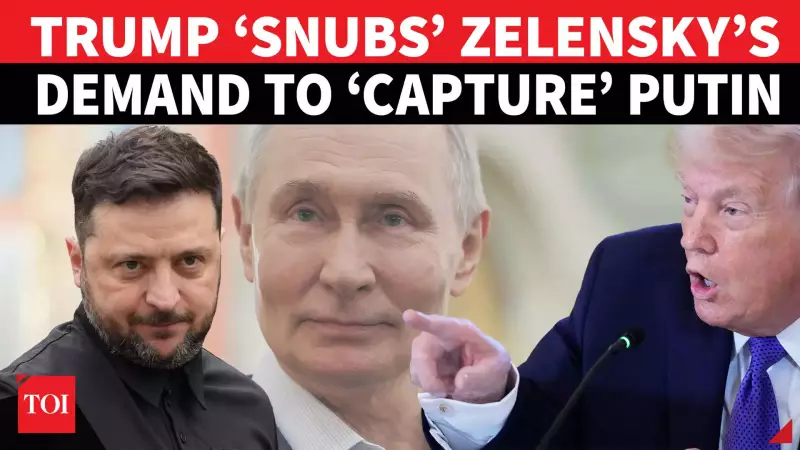
In a significant development that underscores the complex geopolitics of the ongoing Ukraine conflict, US President Donald Trump has publicly dismissed a suggestion from Ukrainian leader Volodymyr Zelensky to capture Russian President Vladimir Putin. The statement came in the wake of the recent seizure of Venezuelan leader Nicolás Maduro by US forces.
Trump's Firm Rejection of a High-Stakes Operation
President Trump, addressing the media, explicitly stated that ordering a mission to apprehend the Russian president would "not be necessary." This firm rejection was delivered on January 10, 2026, directly countering the appeal made by President Zelensky. The Ukrainian leader had pointed to the operation against Maduro as a precedent, suggesting the United States could take similar action against other leaders he termed as dictators, including Putin.
Citing his longstanding personal rapport with the Russian president, Trump expressed his disappointment with the sluggish progress towards a peaceful resolution in the war in Ukraine. His comments indicate a continued preference for diplomatic channels over direct military confrontation with Moscow at the highest level.

The Context: Zelensky's Appeal and the Maduro Precedent
The entire episode was triggered by the dramatic capture of Venezuelan President Nicolás Maduro by American forces. This event prompted President Zelensky to publicly urge the US to consider extending such decisive actions to other global strongmen, with Putin being the primary target of his suggestion. Zelensky's plea was seen as a desperate attempt to leverage the Maduro incident to intensify pressure on the Kremlin.
However, Trump's swift and clear dismissal highlights a stark divergence in strategy and risk assessment between the two allies. While Ukraine seeks any avenue to weaken Russia's leadership, the US administration appears to be calculating the monumental escalatory risks such an act would entail, potentially triggering a direct and uncontrollable conflict between nuclear powers.
Broader Implications and Regional Reactions
Trump's statement is likely to have immediate repercussions. It signals to Kyiv that there are clear limits to US involvement, even under an administration willing to take bold steps like the Maduro operation. For the Kremlin, it may be interpreted as a temporary reassurance, though tensions remain critically high.
The news cycle surrounding this event also included reports of continued violence, with Russian Shahed drone swarms attacking President Zelensky's hometown and the city of Lviv, framed by some Russian outlets as retaliation for other strikes. Furthermore, the situation has rippled into other geopolitical hotspots, with Trump issuing warnings to Iran's Supreme Leader Ali Khamenei and making statements concerning China's Xi Jinping and even a controversial mention of Greenland.
This series of events paints a picture of a volatile global landscape where the rules of engagement are being tested. Trump's decision to draw a line at targeting Putin establishes a significant boundary in modern conflict, emphasizing that some red lines, even for a confrontational administration, remain firmly in place.






