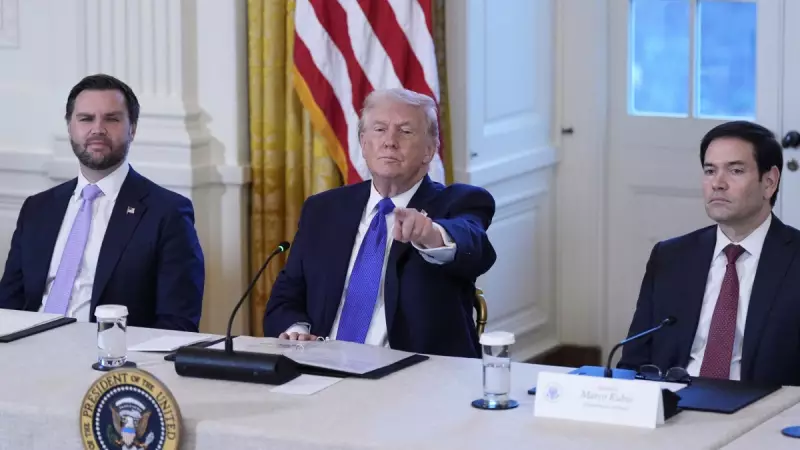
In a significant revelation, former United States President Donald Trump has indicated that his administration had concrete plans regarding Greenland, driven by strategic concerns over growing Russian and Chinese influence in the Arctic region. The statements, made during a recent interview, underscore the high-stakes geopolitical competition unfolding in the resource-rich and strategically vital area.
Trump's Strategic Rationale: Countering Rivals in the Arctic
Donald Trump explicitly framed the potential US action concerning Greenland as a pre-emptive move against America's global competitors. He expressed a clear and present worry that if the United States did not establish a stronger foothold, other major powers would swiftly move in. "We're going to do something" with Greenland, Trump stated, directly citing the risk of Russia and China taking over the autonomous Danish territory.
This perspective aligns with long-standing observations from security analysts who note the Arctic's increasing militarization and economic importance. As climate change opens new shipping routes and access to untapped natural resources, nations are vying for position. Trump's comments confirm that his administration viewed Greenland not just as a remote island, but as a critical piece in a global power puzzle, where inaction could lead to a significant strategic advantage for rivals.

The Historical Context and Diplomatic Ripples
This is not the first time Greenland has been in the spotlight during Trump's political career. Recall that in 2019, his interest in purchasing the world's largest island was publicly reported, an idea that was promptly and firmly rebuffed by the Danish government, leading to a diplomatic spat. The then-Prime Minister of Denmark, Mette Frederiksen, called the notion "absurd," causing Trump to postpone a planned state visit.
The recent interview reiterates that the consideration was far from a fleeting whim. It was a calculated, though unconventional, part of a broader foreign policy aimed at securing American interests. The focus on Greenland highlights a transactional and asset-based view of geopolitics, where territorial control is paramount. The renewed mention of this plan signals that the strategic thinking behind it remains relevant in certain political circles, potentially influencing future US policy in the Arctic under a possible second Trump term.
Implications for Global Geopolitics and Arctic Future
The public airing of these intentions has several immediate consequences. Firstly, it brings the Arctic geopolitical competition into sharper public focus, highlighting it as a zone of potential conflict rather than just scientific cooperation. Secondly, it puts the government of Greenland and its sovereign authority, Denmark, on notice that their territory remains a subject of great power interest.
For Russia and China, Trump's warnings serve as both an accusation and a challenge. Russia has been steadily modernizing its Arctic military bases, while China, declaring itself a "near-Arctic state," has invested heavily in polar research and infrastructure projects under its Belt and Road Initiative. A more assertive US posture, as suggested by Trump, could accelerate an arms race and resource scramble in the fragile Arctic ecosystem.
Ultimately, Trump's statements about Greenland reveal a foundational tenet of his "America First" foreign policy: the belief that strategic assets must be secured proactively, by any means necessary, to prevent them from falling into the hands of adversaries. Whether through purchase, enhanced partnership, or other means, the goal was clear—to ensure American dominance and block the expansion of Russian and Chinese power in a region deemed critical for the 21st century.