

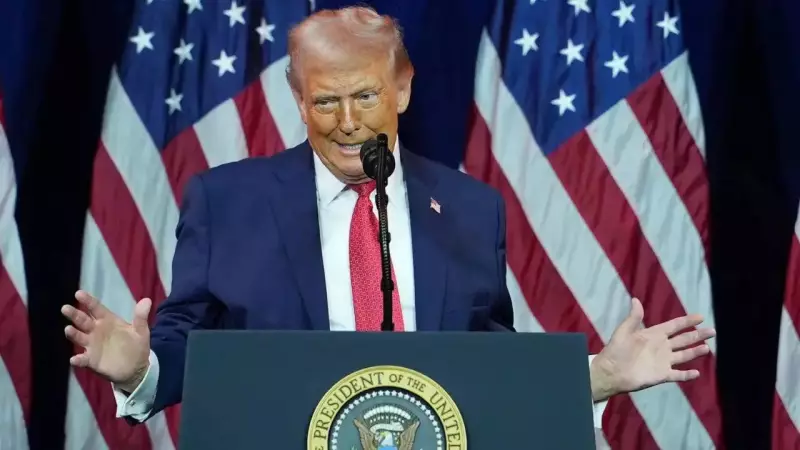
In a significant revelation, US President Donald Trump has outlined a vision for prolonged American oversight of Venezuela, explicitly stating that the United States could "run" the South American nation and exploit its enormous oil reserves for years to come. This marks the clearest indication yet that Washington's involvement following the removal of Nicolás Maduro is intended to be a long-term engagement.
"Much Longer" Than a Year: US Plans for Venezuela
Speaking to The New York Times, President Trump was ambiguous about the exact duration but emphasised an extended timeline. When questioned if US oversight would last months or a year, he replied, "I would say much longer." He asserted that despite having no troops stationed on the ground, the US was effectively in charge due to Venezuela's full cooperation. "They're giving us everything that we feel is necessary," Trump stated, adding his desire to visit the country when it becomes safe.
These comments follow a dramatic operation by US special forces that led to the capture of former Venezuelan leader Nicolás Maduro and his wife, Cilia Flores. They were swiftly transported to New York to face charges related to drugs and weapons. The White House has framed this operation as a game-changer. White House Press Secretary Karoline Leavitt declared that Washington now possesses "maximum leverage" over the interim authorities in Caracas, ensuring their decisions are "dictated by the United States of America."

Oil as the Central Pillar of Control
At the heart of Washington's strategy lies Venezuela's oil wealth, which includes the world's largest proven crude reserves. The Trump administration has made it clear that overseeing the sale of Venezuelan oil is a primary objective. This week, plans were announced for the US to sell between 30 million and 50 million barrels of Venezuelan oil at prevailing market rates.
The proceeds from these sales are mandated to be used exclusively for purchasing American-made goods. President Trump listed agriculture, machinery, medical devices, and energy equipment as key sectors for these purchases. Vice President JD Vance succinctly explained the approach: "the way that we control Venezuela is we control the purse strings." He elaborated that the interim regime would be allowed to sell oil only as long as it serves America's national interest.
Energy Secretary Chris Wright confirmed that the plan extends beyond clearing existing stockpiles. "We're going to market the crude coming out of Venezuela… and then indefinitely, going forward, we will sell the production that comes out of Venezuela," he stated. Reports from The Wall Street Journal suggest the administration is even considering measures to exert control over Venezuela's state oil company, PDVSA, aiming to influence hemispheric oil prices.
Pushback from Caracas and the Path Ahead
Venezuela's interim leader, Delcy Rodríguez, has forcefully rejected the notion of foreign rule, insisting there is "no foreign power governing Caracas." She described the US operation as an unprecedented rupture in bilateral relations. However, Rodríguez attempted to separate politics from commerce, noting that trading with the US was "not unusual or irregular."
Caracas reported that at least 100 people were killed and a similar number wounded during the US-led attack, with Interior Minister Diosdado Cabello claiming Maduro and his wife were among the injured. Meanwhile, US Secretary of State Marco Rubio assured sceptical lawmakers that the administration had a structured plan, outlining a second phase focused on economic recovery and national reconciliation, which would involve US and Western companies gaining market access.
Looking forward, President Trump is scheduled to meet with executives from major US oil companies to discuss potential investments in Venezuela's ageing energy infrastructure. While PDVSA has acknowledged discussions for oil sales within existing frameworks, US officials hint at far more ambitious, long-term control over the nation's primary resource, setting the stage for a complex new chapter in US-Venezuela relations.






