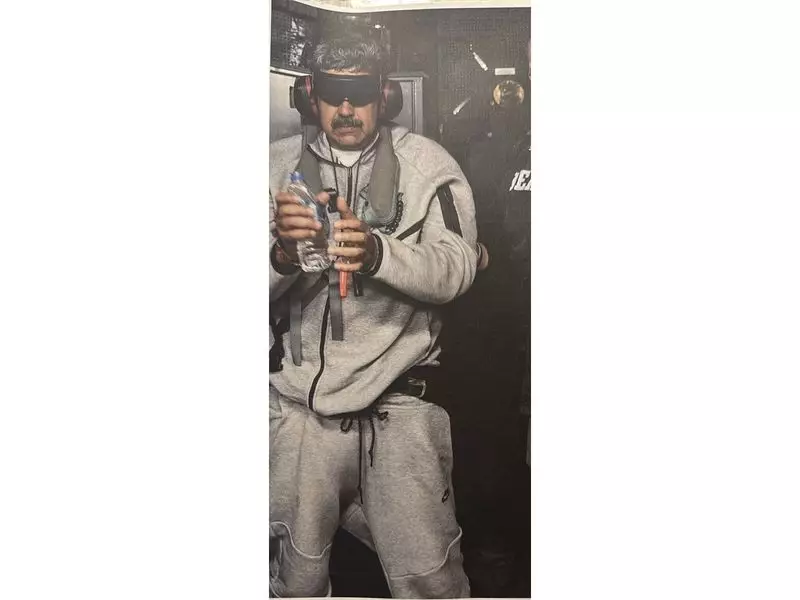
In a move that has ignited a fresh diplomatic firestorm, former US President and current presidential candidate Donald Trump posted a highly controversial image on his Truth Social platform. The photo depicted Venezuela's socialist leader, Nicolas Maduro, seemingly in custody, being escorted by law enforcement officers.
The Provocative Post and Its Immediate Fallout
The image was shared by Trump on a Saturday, accompanied by a caption that read, "This is what I will do to the Oppressors, Thugs, and Tyrants of the world." The post was explicitly linked to a fundraising effort for his 2024 presidential campaign, turning a geopolitical statement into a direct appeal for financial support. While the photo appeared realistic to a casual observer, it was quickly identified by experts and media outlets as a digitally altered or AI-generated creation.
The visual was stark: it showed Maduro, who has led Venezuela since 2013, with his hands restrained behind his back, flanked by two officers in what resembled US-style law enforcement uniforms. The backdrop suggested an institutional setting, adding to the fabricated scene's perceived authenticity. The post represents a significant escalation in Trump's long-standing and vocal opposition to Maduro's regime, which his administration had previously sought to overthrow through sanctions and support for opposition leader Juan Guaido.

Historical Context and Venezuela's Furious Response
The relationship between Trump and Maduro has been profoundly hostile. During his presidency from 2017 to 2021, Trump imposed crippling economic sanctions on Venezuela's vital oil industry, recognized opposition figure Juan Guaido as the country's legitimate interim president, and repeatedly hinted at the possibility of military intervention. The current Biden administration has maintained some sanctions but has also engaged in limited diplomacy, including a recent prisoner swap.
Venezuela's government reacted with fury and condemnation. Jorge Rodriguez, the president of the country's National Assembly and a key Maduro ally, denounced the post in the strongest terms. He accused Trump of inciting violence and attempting to justify a future "fascist aggression" against Venezuela. Rodriguez framed the manipulated image as part of a broader pattern of US imperialism and a direct threat to Venezuela's sovereignty and peace.
Broader Implications for Diplomacy and Digital Ethics
This incident transcends a mere political spat. It raises serious questions about the use of AI-generated content in international relations and election campaigning. The deployment of a deepfake or digitally manipulated image by a major presidential candidate to portray a foreign head of state in a humiliating and false scenario sets a dangerous precedent. It blurs the lines between political rhetoric and the fabrication of reality, with potential consequences for diplomatic channels and global stability.
Analysts suggest the post serves multiple purposes for Trump's campaign:
- Reinforcing a strongman image: It visually communicates his promise to be tough on foreign adversaries.
- Mobilising his base: The anti-socialist, anti-tyrant message resonates strongly with his core supporters.
- Dominating the news cycle: The provocative nature guarantees widespread media coverage.
The event also highlights the challenges platforms face in moderating politically sensitive, AI-generated content from influential figures. As the 2024 US election heats up, this episode is likely to be a precursor to further digital manipulation in political discourse, with international relations becoming a central theatre for this new form of hybrid campaigning.