

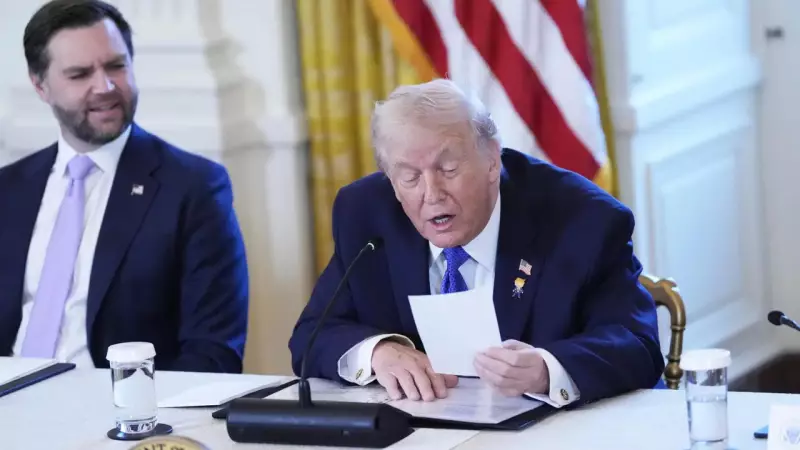
In a controversial social media post, former US President Donald Trump shared an image purportedly from his Wikipedia page that declared him the "Acting President of Venezuela." The move comes during a period of intense political upheaval in the South American nation following a dramatic US-led military operation.
The Doctored Post and Its Claims
On Sunday, Trump posted the image on his Truth Social platform. The screenshot listed him as assuming the office of "Acting President of Venezuela" on January 20, 2025, and remaining incumbent as of January 2026. It also identified current US Vice President JD Vance as his deputy in this purported role.
However, the image was quickly identified as manipulated. No legal framework or official documentation exists that grants the US president any governing authority in Venezuela. The post appears to be a digital fabrication, though its sharing by a major political figure has sparked significant discussion.

Background: The Capture of Nicolas Maduro
The provocative social media activity coincides with major developments on the ground. The controversy stems from a recent US military operation in Caracas that resulted in the capture of former Venezuelan president Nicolas Maduro and his wife, Cilia Flores.
According to US officials speaking to CBS News, the operation was executed by the elite US Army Delta Force. This action followed months of a noticeable US military build-up in the region, which included the deployment of the aircraft carrier USS Gerald R. Ford and other naval assets to the Caribbean.
Maduro and Flores were flown to New York and are currently held at the Metropolitan Detention Center in Brooklyn. They face federal charges related to drug trafficking and alleged cooperation with gangs designated by the US as terrorist organisations. Maduro has denied all allegations.
Political Transition in Venezuela and US Statements
Following Maduro's removal, Venezuela's political machinery moved swiftly. Last week, Delcy Rodríguez, the country's vice president and oil minister, was formally sworn in as the interim president. The 56-year-old lawyer, a senior figure within the ruling political movement, took the oath before the National Assembly, which is led by her brother, Jorge Rodríguez.
The ceremony also saw the swearing-in of 283 lawmakers elected in parliamentary elections held in May. Most opposition parties had boycotted that vote, resulting in a legislature dominated by pro-government figures. The only absent lawmaker was Cilia Flores, who remains in US custody.
Earlier, President Trump stated that the United States would temporarily "run" Venezuela during a transition period to "get the oil flowing," later asserting the US was "in charge." However, Secretary of State Marco Rubio later sought to clarify, stating the US does not intend to directly govern Venezuela. Instead, he described plans for an "oil quarantine" as part of efforts to influence policy outcomes.
The combination of a real-world military intervention, a major political transition in Caracas, and online disinformation from a key US political leader creates a volatile and highly unusual geopolitical situation. The events underscore the complex interplay between digital propaganda and physical power in modern international affairs.






